>
Clupeiformes (Herrings) >
Engraulidae (Anchovies) > Coiliinae
Etymology: supra: Name from Latin adverb 'supra', referring to the higher counts of scales, fin rays, and gill rakers when compared with related species.
Environnement : milieu / zone climatique / profondeur / gamme de distribution
Écologie
marin pelagic-neritic. Tropical
Western Indian Ocean: Pakistan.
Taille / Poids / Âge
Maturité: Lm ? range ? - ? cm
Max length : 13.5 cm SL mâle / non sexé; (Ref. 123974)
Description synthétique
Clés d'identification | Morphologie | Morphométrie
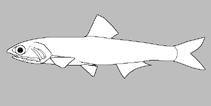
This species is distinguished by the following set of characters: upper jaw is relatively long with posterior tip slightly beyond opercle posterior margin, but not reaching the pectoral-fin insertion; first supramaxilla absent; teeth on both jaws are robust, enlarged; dorsum with distinct paired dark lines when preserved; a dark blotch behind the upper part of gill opening sometimes present in preserved specimens; branched rays of dorsal fin 10-11 (modally 10), anal fin usually 42-45 (rarely 40, modally 44), pectoral fin with 11-12 (modally 11); transverse scales 12-13 (12); scale rows in longitudinal series 45-47 (46); gill rakers on first gill arch, in upper series15-16 (15), lower series 20-23 (22), total 35-39 (37); gill rakers on second gill arch, in upper series 12-14 (modally 13), lower series 21-23 (22), total 33-37 (35); gill rakers on third gill arch, in upper series 10-11 (10), lower series 12-14 (13), total 22-24 (23); gill rakers on fourth gill arch, in upper series 7-9 (8), lower series 10-13 (11), total 18-22 (19); snout is long, 3.7-4.1% SL; pelvic fin is long, 9.0-10.4% SL; mandible is long, 17.3-18.3% SL; pelvic-fin insertion to anal-fin origin 17.0-18.8% SL (Ref. 123974).
Cross section: compressed.
Cycle de vie et comportement reproducteur
Maturité | Reproduction | Frai | Œufs | Fécondité | Larves
Hata, H., P.N. Psomadakis, H.B. Osmany and H. Motomura, 2021. A new species of Thrissina from Pakistan (Arabian Sea), with redescription of Thrissina whiteheadi (Wongratana 1983) (Clupeiformes: Engraulidae). Ichthyol. Res. 68(4):486-495. (Ref. 123974)
Statut dans la liste rouge de l'IUCN (Ref. 130435: Version 2025-2 (Global))
Menace pour l'homme
Harmless
Utilisations par l'homme
Outils
Articles particuliers
Télécharger en XML
Sources Internet
Estimations basées sur des modèles
Indice de diversité phylogénétique (Réf.
82804): PD
50 = 0.5020 [Uniqueness, from 0.5 = low to 2.0 = high].
Bayesian length-weight: a=0.00389 (0.00178 - 0.00849), b=3.10 (2.92 - 3.28), in cm total length, based on LWR estimates for this (Sub)family-body shape (Ref.
93245).
Niveau trophique (Réf.
69278): 3.4 ±0.5 se; based on size and trophs of closest relatives
Résilience (Réf.
120179): Haut, temps minimum de doublement de population inférieur à 15 mois (Preliminary K or Fecundity.).
Vulnérabilité de la pêche (Ref.
59153): Low vulnerability (10 of 100).
🛈