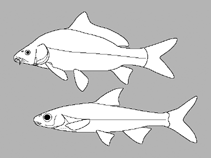
分類 / 名前
共通名の | 類義語 | Catalog of Fishes(部類, 種) | ITIS | CoL | WoRMS | Cloffa
>
Cypriniformes (Carps) >
Cyprinidae (Minnows or carps) > Smiliogastrinae
Etymology: Enteromius: Greek, enteron = intestine + Greek, myo, mys = muscle (Ref. 45335); radari: This species is dedicated to Dr. Honoris Radar Nishilu, former chief manager of the Kahuzi-Biega National Park (2008-2016), in recognition of his commitment to and support for biodiversity assessments and scientific research in the park and particularly for the investigations (Ref. 128600).
環境:環境 / 気候帯 / 深さの範囲 / 分布範囲
生態学
; 新鮮な水 底生の漂泳性; pH range: 6.5 - 7.0. Tropical; 23°C - 23°C (Ref. 128600)
Africa: Democratic Republic of the Congo.
サイズ / 重さ / 年齢
成熟: Lm ? range ? - ? cm
Max length : 8.7 cm SL オス/雌雄の選別がない; (Ref. 128600)
簡単な記述
検索表 | 形態学 | 形態計測学
背面の脊椎 (合計) : 0; 背鰭 (合計) : 10 - 11; 肛門の骨: 0; 臀鰭: 8; 脊つい: 31 - 33. Diagnosis: Within the Congo basin, Enteromius radari belongs to the group of sawfin minnows with a thickened last unbranched dorsal-fin ray and is thereby distinguished from all congeners from the Congo basin with a soft last unbranched dorsal-fin ray (Ref. 128600). It differs from other species with a weakly thickened spine, notably E. mediosquamatus, E. taeniurus and E. tomiensis, by its serrations on the spine vs. unserrated dorsal spine (Ref. 128600). Within the group of the sawfin minnows, having a thickened spine with serrations, it differs from E. afrovernayi, E. apleurogramma, E. oligogrammus and E. petchkovskyi by its complete lateral line vs. incomplete; in addition, it differs from E. apleurogramma and E. oligogrammus by its weakly thickened dorsal spine vs. a strongly thickened, and further by its lower number of lateral line scales from E. afrovernayi, 22-26 vs. 29-32; it differs from the remaining sawfin minnows by its weakly thickened, thin dorsal spine of which only the middle part is weakly serrated, vs. a strongly thickened, stout spine, well serrated over almost its entire length in E. ansorgii, E. eutaenia, E. kerstenii as well as E. tangandensis, E. mattozi, E. miiolepis, E.neumayeri, E. pellegrini and E. trinotatus; it can further be distinguished from E. pellegrini by its lower number of lateral line scales, 22-26 vs. 28-30; it can be distinguished from E. afrohamiltoni, E. lukindae, E. neumayeri, E. paludinosus, E. trimaculatus and E. vanderysti by its lower number of lateral line scales, 22-26 vs. 29-33, 29-30, 30-31, 34-39, 30-36 and 29, respectively (Ref. 128600). Furthermore, based on its colour pattern, E. radari can be distinguished from E. eutaenia, E. devosi, E. miolepis and E. luikae by the presence of three or four blotces along the flanks, situated just above the lateral line, and interconnected or not by a narrow, sometimes inconspicuous, black stripe vs. a permanent, continuous, black mid-lateral band; E. radari can be distinguished from E. guirali and E. machadoi as well, by the presence of these black markings along the body flanks vs. absence; E. radari can be distinguished from E. multilineatus and E. trinotatus also, by the above black marking character vs. a large black, mid-lateral band on the body but with several thin longitudinal black bands above and below this main band, and three elongated, narrow black spots respectively (Ref. 128600). Within the group of Enteromius species with a weakly thickened, serrated spine, it differs from E. chicapaensis and E. chiumbeensis by its higher number of lateral line scales, 22-26 vs. 21-23 and 20-21, respectively; in addition, it differs from E. chicapaensis by the presence of a series of three or four black blotches just above the mid-lateral line of the body vs. absence; furthermore, within this group it differs from E. holotaenia and E. martorelli by a series of three or four black blotches just above the mid-lateral line of the body vs. a continuous black band; finally, E. radari differs clearly from E. janssensi by the absence of cephalic pitlines vs. presence, and by the presence of blotches vs. indistinct black band larger on the anterior part and narrowing at mid-body level, by its lower number of lateral line scales, 22-26 vs. 24-27, and its lower number of circumpeduncular scales, 10-12 vs. 12 (Ref. 128600).
Found in shallow areas, about 1 m of depth, of small streams, about 1-10 m width, under tree canopy cover; the bottom is composed of either silt, sand, gravel, or a combination with mud and detritus (Ref. 128600).
ライフサイクルと交尾行動
成熟 | 繁殖 | 放精 | 卵 | 生産力 | 幼生
Kisekelwa, T., J. Snoeks, E. Decru, F.B.D. Schedel, M. Isumbisho and E. Vreven, 2022. A mismatch between morphological and molecular data in lineages of Enteromius (Cypriniformes: Cyprinidae) from the Lowa basin (East Democratic Republic of the Congo: DRC) with the description of a new species. Syst. Biodivers. 20(1,2135630):1-22. (Ref. 128600)
IUCNのレッドリストの状況は (Ref. 130435: Version 2025-2 (Global))
人間の用途
水産業: 興味がない
用具
特記事項
XMLをダウンロードして下さい
インターネットの情報源
モデルに基づく推定値
系統多様性指数 (参照
82804): PD
50 = 0.5000 [Uniqueness, from 0.5 = low to 2.0 = high].
Bayesian length-weight: a=0.01122 (0.00521 - 0.02417), b=3.01 (2.84 - 3.18), in cm total length, based on LWR estimates for this Genus-body shape (Ref.
93245).
栄養段階 (参照
69278): 3.0 ±0.3 se; based on size and trophs of closest relatives
回復力 (参照
120179): 高い, 15か月以下の倍増期間の最小個体群 (Preliminary K or Fecundity.).
漁業の脆弱性 (Ref.
59153): Low vulnerability (10 of 100).
🛈