分類 / 名稱
俗名 | 同種異名 | Catalog of Fishes(屬, 種) | ITIS | CoL | WoRMS | Cloffa
Teleostei >
Characiformes (Characins) >
Acestrorhamphidae (American tetras) > Hyphessobryconinae
Etymology: Hyphessobrycon: Greek, hyphesson, -on, -on = a little smaller + Greek, bryko = to bite (Ref. 45335); comodoro: Named for its type locality, Municipality of Comodoro, Mato Grosso State, and it is also the name of a senior naval rank used in many navies, which inspired the municipality’s name; noun in apposition.
環境: 環境 / 氣候帶 / 深度上下限 / 配送範圍
生態學
; 淡水 底中水層性; 深度上下限 0 - 2 m (Ref. 128640).
分布
領土 | FAO區域 | 生態系 | 發現紀錄 | 分布圖 | 簡介 | Faunafri
South America: Brazil.
大小 / 重量 / 年齡
成熟度: Lm ? range ? - ? cm
Max length : 3.9 cm SL 雄魚/尚未辨別雌雄; (Ref. 128640)
簡短描述
檢索表 | 型態特徵 | 形態測量圖
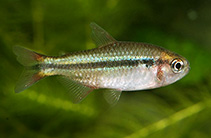
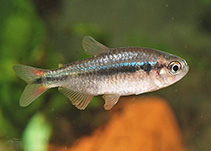
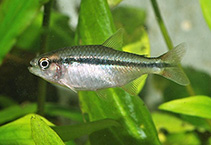
This species is distinguished from all its congeners, except Hyphessobrycon cachimbensis, H. cyanotaenia, H. fernandezi, H. melanostichos, H. nigricinctus, H. paucilepis, H. petricolus, H. piranga, H. psittacus, H. scholzei, H. sovichthys, H. stegemanni, H. taphorni, H. tuyensis and H. vilmae by having a well-defined and relatively narrow dark midlateral stripe on body, extending from head to the middle caudal-fin rays (vs. no well-defined longitudinal stripe or stripe wider than the orbit, or stripe starting approximately vertically through the origin of the dorsal fin or stripe blurred posteriorly); differs from the aforementioned species, except H. cachimbensis, H. cyanotaenia, H. melanostichos, H. nigricinctus, H. petricolus, by having a humeral blotch
(vs. no humeral blotch absent); differs from H. cachimbensis, H. cyanotaenia by having the distal profile of the anal fin falcate in males (vs. approximately straight or convex) and from <>H. cachimbensis, H. petricolus, H. nigricinctus by having 13-16 branched anal-fin rays (vs. 17-26); differs further from H. cyanotaenia by lacking concentration of black pigmentation on longest rays of dorsal, pelvic, and anal fins (vs. pigmentation present); differs from H. melanostichos (the most similar congener) by having 11 or 12 horizontal scale rows around caudal peduncle (vs. 14), fewer branched pelvic-fin rays 6 (vs. 7), humeral blotch wider than
deep, with pigmentation much more intense than the dark midlateral band, with well-defined edges (vs. humeral blotch deeper than wide, with pigmentation similar to the dark midlateral band, without well-defined edges); differs from H. melanostichos by having 13-15 (mode 14, rarely 16 (only 3 of 30 specimens), branched anal-fin rays (vs. 16–18, mode 16) (Ref. 128640).
Cross section: compressed.
Collection areas are impoundments of tributaries of the rio Mutum formed by the road building, where the water is transparent, with maximum widths ranging 50-60 m and depth 0.3-2 m. The substrate is formed by sand, silt, and organic matter, with the presence of submerged aquatic macrophytes and large amounts of filamentous algae. The only other species collected syntopically was Hoplerythrinus unitaeniatus (Spix & Agassiz, 1829), which is probably a predator of the H. comodoro. The streams that form the lagoons are small, 2-4 m wide and 0.5-2 m deep, with clear rapid waters and a bottom composed of sand and leaf litter. Local vegetation is composed of secondary forest. The other known locality lies at the rio Mutum itself, downstream to the other two and here the new species occurs syntopically with Hyphessobrycon hexastichos and Hasemania nambiquara. The diet was mainly composed of resources autochthonous (91.6% of the volume of food items), mainly vegetable fragments (57.7%) and aquatic insects (32.7%). The vegetable fragments were composed of aquatic macrophyte structures and the aquatic insects were fragments of adults, larvae, and pupae of Diptera and larvae of Trichoptera, and Odonata). Specimens analyzed were collected in a region under moderate anthropogenic pressure, which may influence the diet of fish species. Further, damming streams to road building changes the taxonomic and functional of fish assemblages and limits the longitudinal dispersion. The transformation from lotic to lentic environments, with an increase in the width of the canopy-opening channel, creates pelagic and benthic areas that allow the proliferation of macrophytes and algae. Biological data taken from regions impacted by human action has high scientific value, but in the case of this species, it is crucial that the data also be available from less impacted environments (Ref. 128640).
生命週期和交配行為
成熟度 | 繁殖 | 產卵場 | 卵 | 孕卵數 | 仔魚
Dagosta, F.C.P., T.J. Seren, A. Ferreira and M.M.F. Marinho, 2022. The emerald green tetra: a new restricted-range Hyphessobrycon (Characiformes: Characidae) from the upper rio Juruena, Chapada dos Parecis, Brazil. Neotropical Ichthyol. 20(1):e210119:1-15. (Ref. 128640)
IUCN 瀕危狀態 (Ref. 130435: Version 2025-2 (Global))
人類使用
漁業: 潛在的興趣
工具
特別的報告
下載 XML
網路資源
基於模型的估計
系統發育多樣性指數 (參考文獻
82804): PD
50 = 0.5000 [Uniqueness, from 0.5 = low to 2.0 = high].
Bayesian length-weight: a=0.00676 (0.00269 - 0.01698), b=3.12 (2.90 - 3.34), in cm total length, based on LWR estimates for this (Sub)family-body shape (Ref.
93245).
營養階層 (參考文獻
69278): 2.9 ±0.3 se; based on size and trophs of closest relatives
回復力 (參考文獻
120179): 高度, 族群倍增時間少於 15個月 (Preliminary K or Fecundity.).
釣魚的脆弱性 (Ref.
59153): Low vulnerability (10 of 100).
🛈