Klassificering / Namn
Populärnamn | synonymer | Catalog of Fishes(Släkte, Arter) | ITIS | CoL | WoRMS | Cloffa
>
Siluriformes (Catfishes) >
Aspredinidae (Banjo catfishes) > Hoplomyzontinae
Etymology: taquari: Named for rio Taquari, a word of Tupi language origin (takwa’ri) combining ta’kwara (a common name for bamboo-like plants of family Poaceae) plus ‘i’ for diminutive; a noun in apposition.
Eponymy: Dr Adolfo (also spelled Adolf) Ernst (1832–1899) was a biologist, born in Prussia and a graduate of the University of Berlin. [...] (Ref. 128868), visit book page.
Miljö: miljö / Klimatzon / djupintervall / distributionsområde
Ekologi
; sötvatten bottenlevande. Tropical
South America: Brazil.
Storlek / Vikt / Ålder
Könsmognad: Lm ? range ? - ? cm
Max length : 2.3 cm SL hane/ej könsbestämd; (Ref. 124573)
Kort beskrivning
Bestämningsnycklar | Morfologi | Morfometri
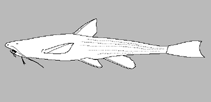
This species is distinguished from all its congeners by the following characters: relatively narrow bilateral bony shields on dorsal and ventral series, these do not overlap or contact each other anywhere in both series (vs. adjacent shields contacting or overlapping along most or entire series; this trait also separates this species from most hoplomyzontine species except those of Hoplomyzon); with seven or eight serrations on the posterior margin of the pectoral spine (vs. 10-18); pectoral-fin spine only slightly larger than subsequent soft rays, there is a gradual transition between the spine and the rest of fin (vs. spine 25% longer or more than soft rays, leaving a large portion of protruding spine without corresponding fin web distally); differs from E. megistus by having a well-developed rictal barbel (vs. no barbel or reduced to bump); differs from E. intosus by the unbranched maxillary barbel (vs. with thread-like secondary barbels); no dentations along the anterior margin of the pectoral fin (vs. with dentations); with two pairs of stout and regularly-positioned mental barbels (vs. over 100 thread-like and uniformly distributed barbels); D i+4 (vs. i+7); A i+6 anal-fin rays (vs. viii+4); basipterygium entirely hidden in integument (vs. anterolateral arm of basipterygium exposed on the skin, forming rugose shield) (Ref. 124573).
Cross section: flattened.
Collected in a white water river, with moderate water flow, over rock and sand. Its habitat is not the deep bottom of a large river, but rather a small river accessible by hand-seining. Aquatic macrophytes were present in some sites and riparian forest was well preserved; all specimens were collected in a shaded sector covered with dense vegetation and large rocks on the bottom (Ref. 124573).
Livscykel och parningsbeteende
Könsmognad | Reproduktion | Lek | Ägg | Fekunditet | Larver
Dagosta, F.C.P. and M. de Pinna, 2021. Two new catfish species of typically Amazonian lineages in the Upper Rio Paraguay (Aspredinidae: Hoplymyzontinae and Trichomycteridae: Vandelliinae), with a biogeographic discussion. Pap. Avulsos Zool. 61:e20216147. (Ref. 124573)
Status på IUCN:s rödlista (Ref. 130435: Version 2025-2 (Global))
Hot mot människor
Harmless
Mänskliga användningsområden
Verktyg
Särskilda rapporter
Ladda ner XML
Internet-källor
Uppskattningar baserade på modeller
Index för fylogenetisk mångfald (Ref.
82804): PD
50 = 0.5312 [Uniqueness, from 0.5 = low to 2.0 = high].
Bayesian length-weight: a=0.00389 (0.00180 - 0.00842), b=3.12 (2.94 - 3.30), in cm total length, based on all LWR estimates for this body shape (Ref.
93245).
Trofisk nivå (Ref.
69278): 3.0 ±0.3 se; based on size and trophs of closest relatives
Sårbarhet i fisket (Ref.
59153): Low vulnerability (10 of 100).
🛈