分类 / 名称
俗名 | 同种异名 | Catalog of Fishes(属, 种) | ITIS | CoL | WoRMS | Cloffa
Teleostei >
Perciformes/Zoarcoidei (Eelpouts and pricklebacks) >
Eulophiidae ("Spinous fin eelpouts")
Etymology: Eulophias: Eulophias is derived from the combination of two Greek words meaning 'well' and 'one having a bristly back'; spinosior: Name derived from the comparative of the Latin adjective 'spinosus' for thorny, spiny, or prickly, referring to having the greater number of dorsal-fin spines compared to its congeners.
环境:氛围 / 气候带 / 深度上下限 / 分布范围
生态学
海洋 居于水底的; 深度上下限 257 - 555 m (Ref. 128434), usually ? - 300 m (Ref. 128434).
分布
领土 | FAO区域 | 生态系 | 标本纪录 | 分布图 | 简介 | Faunafri
Northwest Pacific: Japan.
大小 / 重量 / 年龄
成熟度: Lm ? range ? - ? cm
Max length : 18.2 cm SL 雄鱼/尚未辨别雌雄; (Ref. 128434)
简单描述
检索表 | 型态特徵 | 形态测量图
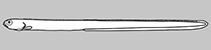
背棘 (总数) : 133 - 143; 背的软条 (总数) : 7 - 12; 臀鳍软条: 109 - 116; 脊椎骨: 146 - 156. This species is distinguished from its its two congeners by the following characters: D spines 133-143 dorsal-fin (vs. 124-128 in E. koreanus and 116-125 in E. tanneri); A 109-116 (vs. 102-103 koreanus, 90-100 tanneri); total vertebrae 146-156 (vs. 141-143 koreanus, 132-143 tanneri ); and, pectoral-fin rays 5-6 (vs. 7 both congeners); further, it is unique in lacking prominent dark markings on the sides of the head and body, whereas E. koreanus and E. tanneri have a dark band posterior to the eye
and a series of dark blotches midlaterally on the trunk and tail (Ref. 128434).
Cross section: oval.
生命周期和交配行为
成熟度 | 繁殖 | 产卵场 | 卵 | 孕卵数 | 仔鱼
Nakayama, N., T. Yamakawa, M. Takami and H. Endo, 2023. Description of a new deep-water eulophiid fish (Perciformes: Zoarcoidei) from Japan. Ichthyology & Herpetology 111(1):87-97. (Ref. 128434)
世界自然保护联盟红皮书 (Ref. 130435: Version 2025-2 (Global))
人类利用
工具
特别资料
下载 XML
网络资源
基于模型的估算
系统发育多样性指数 (参考文献
82804): PD
50 = 0.6562 [Uniqueness, from 0.5 = low to 2.0 = high].
Bayesian length-weight: a=0.00102 (0.00046 - 0.00225), b=3.06 (2.88 - 3.24), in cm total length, based on all LWR estimates for this body shape (Ref.
93245).
营养阶层 (参考文献
69278): 3.3 ±0.5 se; based on size and trophs of closest relatives
渔业脆弱性 (Ref.
59153): Low vulnerability (12 of 100).
🛈