Clasificación / Nombres
Nombres comunes | Sinónimos | Catalog of Fishes(Género, Especie) | ITIS | CoL | WoRMS | Cloffa
>
Siluriformes (Catfishes) >
Sisoridae (Sisorid catfishes) > Sisorinae
Etymology: Glyptothorax: Greek, glyptes = carver + Greek, thorax = breast (Ref. 45335); amnestus: Name from Latinized Greek adjective for forgotten; alluding to the fact that this species has been misidentified for more than 170 years.
Entorno: milieu / zona climática / rango de profundidad / gama de distribución
Ecología
; agua dulce bentopelágico. Tropical
Asia: Indonesia.
Tamaño / Peso / Edad
Madurez: Lm ? range ? - ? cm
Max length : 8.8 cm SL macho / no sexado; (Ref. 128699)
Descripción breve
Claves de identificación | Morfología | Morfometría
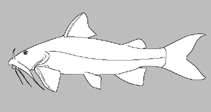
Radios blandos dorsales (total) : 6; Radios blandos anales: 8 - 9; Vértebra: 33 - 36. This species is distinguished from its congeners in Sundaland except for G. decussatus, G. major, G. plectilis in having (vs. lacking) anteromedial striae in the thoracic adhesive apparatus; differs from G. decussatus in lacking (vs. having) a dark vertical bar at the base of the caudal fin in the shape of an irregular cross; differs from G. major in having the anterolateral edges of the thoracic adhesive apparatus almost straight (vs. markedly concave) and a deeper caudal peduncle 9.8-11.2% SL (vs. 7.7-10.1); differs from G. plectilis in having an oblong thoracic adhesive apparatus with almost straight anterolateral edges (vs. ovate with gently convex anterolateral edges) and non-prominent tubercles of uniform size (vs. with prominent, enlarged tubercles) along the flanks; its unique combination of characters further distinguishes this species from Sundaic congeners: approximately half of premaxillary toothband exposed when mouth is closed; eye diameter 6-10% HL; head width 19.9-23.0% SL; margin of dorsal fin concave; dorsal to adipose distance 17.9-23.4% SL; maximum height of adipose fin 2.2-2.6 times in its length, straight dorsoposterior margin of adipose fin; body depth at anus 15.3-20.6% SL; post-adipose distance 15.8-19.7% SL; caudal peduncle depth 1.4-2.2 times in its length and 1.4-2.1 times in body depth at dorsal-fin origin. Colouration: uniformly dark body without contrasting markings; and dark spots on dorsal and lateral surfaces of body (Ref. 128699).
Cross section: oval.
Usually found in upland rivers and streams with a moderately fast current and a substrate composed predominantly of rocks and gravel (Ref. 128699).
Ciclo vital y comportamiento de apareamiento
Madurez | Reproducción | Puesta | Huevos | Fecundidad | Larva
Ng, H.H. and M. Kottelat, 2016. The Glyptothorax of Sundaland: a revisionary study (Teleostei: Sisoridae). Zootaxa 4188(1):001-092. (Ref. 128699)
Situación en la Lista Roja de la UICN (Ref. 130435: Version 2025-2 (Global))
Amenaza para el ser humano
Harmless
Usos humanos
Pesquerías: sin interés
Herramientas
Informes especiales
Descargar XML
Fuentes de Internet
Estimaciones basadas en modelos
Índice de diversidad filogenética (Referencia
82804): PD
50 = 0.5000 [Uniqueness, from 0.5 = low to 2.0 = high].
Bayesian length-weight: a=0.00794 (0.00365 - 0.01726), b=3.02 (2.85 - 3.19), in cm total length, based on LWR estimates for this Genus-body shape (Ref.
93245).
Nivel trófico (Referencia
69278): 3.2 ±0.4 se; based on size and trophs of closest relatives
Resiliencia (Referencia
120179): Medio, población duplicada en un tiempo mínimo de 1.4-4.4 años (Preliminary K or Fecundity.).
Vulnerabilidad pesquera (Ref.
59153): Low vulnerability (10 of 100).
🛈