>
Cyprinodontiformes (Rivulines, killifishes and live bearers) >
Poeciliidae (Poeciliids) > Poeciliinae
Etymology: Poecilia: Greek, poikilos = with a lot of colours (Ref. 45335); islai: Named for Dominic Isla, who passed away before the species was ever formally evaluated.
Eponymy: Dominic Isla (d: 2020) was an aquarist and dealer who ran CoCo Island Aquatics for 45 years (1975–2020). [...] (Ref. 128868), visit book page.
Milieu: milieu / Klimaatzone / Diepte / verspreidingsgebied
Ecologie
; zoet water demersaal. Tropical
North America: Haiti.
Grootte / Gewicht / Leeftijd
Maturiteit: Lm ? range ? - ? cm
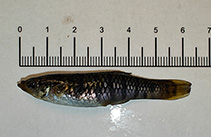
Max length : 6.5 cm TL mannelijk / geslacht onbekend; (Ref. 130676)
Korte beschrijving
Determinatiesleutels | Morfologie | Morfometrie
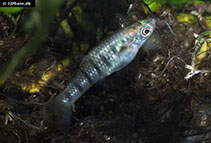
This species is distinguished from all its congeners (Limia sensu lato) except L. nigrofasciata by the following characters: black bars on both sides of the body of males and females (the barred pattern is frequently more conspicuous in this species than in L. nigrofasciata, with darker and wider vertical bars); differs from L. nigrofasciata and other sympatric species (L. grossidens, L. fuscomaculata, L. garnieri, L. immaculata,
L. miragoanensis, L. ornata) in having the origin of the dorsal fin of females slightly posterior to the origin of the anal fin (vs. the origin of the dorsal fin is either slightly anterior or above the origin of the anal fin); differs from all other described species in the genus in having a slender body with body depth approximately equal to the caudal peduncle length; body depth is shorter than caudal peduncle length except in L. nigrofasciata, which has deeper body in relation to the length of the caudal peduncle (more conspicuous in males); number of serrae in the ray 4p of the gonopodium in males (10 segments in all measured specimens); gonapophyses and uncinated processes that support the gonopodium are thicker and more developed (Ref. 128733).
Cross section: compressed.
Known only from its type locality, the Lake Miragoane in south-western Haiti. It was collected in a small, clear water path exiting the north end of the lake and in the lake itself. However it little else is known about the ecology, but it seems that it prefers habitats with some submerged vegetation and muddy bottoms. It was sympatric with Gambusia beebei, Nandopsis haitiensis, Limia nigrofasciata, L. garnieri, L. miragoanensis, L. immaculata and some introduced species, such as Oreochromis aureus and Tilapia rendali (Ref. 128733).
Levenscyclus en paargedrag
Maturiteit | Voortplanting | Paaien | Eieren | Fecunditeit | Larven
Rodríguez-Silva, R. and P.F. Weaver, 2020. A new livebearing fish of the genus Limia (Cyprinodontiformes: Poeciliidae) from Lake Miragoane, Haiti. Fish Biol. 96(6):1360-1369. [First appeared online, pp. 1-10, without Zoobank Registration. New name dates to the printed edition, that appeared on 24 June 2020.] (Ref. 128733)
Status op de Rode Lijst van het IUCN (Ref. 130435: Version 2025-2 (Global))
Gevaar voor de mens
Harmless
Gebruik door de mens
Visserij: commercieel; Aquarium: Commercieel
Tools
Speciale rapporten
Download XML
Internetbronnen
Schattingen op basis van modellen
Fylogenetische diversiteitsindex (Ref.
82804): PD
50 = 0.5000 [Uniqueness, from 0.5 = low to 2.0 = high].
Bayesian length-weight: a=0.01995 (0.00906 - 0.04395), b=3.01 (2.83 - 3.19), in cm total length, based on all LWR estimates for this body shape (Ref.
93245).
Trofisch niveau (Ref.
69278): 2.6 ±0.3 se; based on size and trophs of closest relatives
Weerstandsvermogen (Ref.
120179): Hoog, minimale populatieverdubbelingstijd minder dan 15 maanden (Preliminary K or Fecundity.).
Kwetsbaarheid van de visserij (Ref.
59153): Low vulnerability (10 of 100).
🛈