Classificação / Nomes
Nomes comuns | Sinónimos | Catalog of Fishes(Género, Espécies) | ITIS | CoL | WoRMS | Cloffa
>
Siluriformes (Catfishes) >
Loricariidae (Armored catfishes) > Loricariinae
Etymology: Rhadinoloricaria: Greek, rhadinos, -e, -on = soft, flexible + Latin, lorica, loricare = cuirass of corslet of leather; 1706 (Ref. 45335); papillosa: Name from Latin word 'papillosa'” referring to numerous elongated papillae on the lower lip of specimens examined.
Ambiente: milieu / zona climática / intervalo de profundidade / gama de distribuição
Ecologia
; Água doce demersal. Tropical
South America: Brazil.
Tamanho / Peso / Idade
Maturidade: Lm ? range ? - ? cm
Max length : 7.4 cm SL (female)
Descrição breve
Chaves de identificação | Morfologia | Morfometria
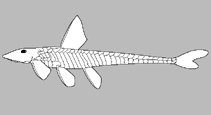
This species is distinguished by the following characters: maxillary barbel extending beyond the pectoral-fin base; teeth few in both jaws (1-2 in premaxilla; 4-6 in dentary); edge of lips with barbelets, surface of lips with papillae and with one thick barbelet behind premaxillae and other two barbelets next to each pre-maxillae; in the holotype the barbelet behind premaxillae ramifies into two conical arms with equal size, while in paratypes this thick barbelet is not ramified; differs from all its congeners by the presence of a unique pattern of the buccal ornamentation, with numerous elongated smooth papillae in irregular rows on lower lip (vs. papillae not elongated; differs from R. macromystax, R. stewarti and R. listrorhinos by having fewer premaxillary teeth, 1-2 (vs. 4-6 in macromystax, stewarti, and 5-6 in listrorhinos), and by having a triangular-shaped head in dorsal view (vs. spatula-shaped head); differs from R. rhami by maxillary barbel reaching the middle of the pectoral fin (vs. maxillary barbel not reaching the gill opening) (Ref. 128857).
Cross section: flattened.
Occurs at the bottom of Rio Negro (Ref. 128857).
Ciclo de vida e comportamento de acasalamento
Maturidade | Reprodução | Desova | Ovos | Fecundidade | Larvas
Crispim-Rodrigues, J.L., M.J. Bernt, B.T. Waltz, G.S.C. Silva, R.C. Benine, C. Oliveira, R. Covain and F.F. Rox, 2023. A new species of mailed catfish of genus Rhadinoloricaria (Siluriformes: Loricariidae: Loricariinae) from Rio Negro basin, Brazil. J. Fish Biol. Early view: [1-10]. [First published online, pp. 1-10, 11 May 2023.] (Ref. 128857)
Categoria na Lista Vermelha da IUCN (Ref. 130435: Version 2025-2 (Global))
Ameaça para o homem
Harmless
Utilização humana
Ferramentas
Relatórios especiais
Descarregue XML
Fontes da internet
Estimativas baseadas em modelos
Índice de diversidade filogenética (Ref.
82804): PD
50 = 0.5020 [Uniqueness, from 0.5 = low to 2.0 = high].
Bayesian length-weight: a=0.00398 (0.00185 - 0.00857), b=3.11 (2.93 - 3.29), in cm total length, based on LWR estimates for this (Sub)family-body shape (Ref.
93245).
Nível Trófico (Ref.
69278): 2.7 ±0.2 se; based on size and trophs of closest relatives
Resiliência (Ref.
120179): Elevada, tempo mínimo de duplicação da população menor que 15 meses (Preliminary K or Fecundity.).
Vulnerabilidade da pesca (Ref.
59153): Low vulnerability (10 of 100).
🛈