Classification / Noms
Noms communs | Synonymes | Catalog of Fishes(Genre, Espèce) | ITIS | CoL | WoRMS | Cloffa
>
Perciformes/Scorpaenoidei (Scorpionfishes) >
Scorpaenidae (Scorpionfishes or rockfishes) > Scorpaeninae
Etymology: Phenacoscorpius: Greek, phenax, -akos = deceptive + Greek, skorpion = scorpion (Ref. 45335); longicaudalis: Name from Latin word meaning 'long caudal', in reference to the relatively long caudal; noun in apposition (Ref. 128947).
Environnement : milieu / zone climatique / profondeur / gamme de distribution
Écologie
marin bathydémersal; profondeur 228 - 990 m (Ref. 128947). Tropical
Eastern Indian Ocean: Western Australia.
Taille / Poids / Âge
Maturité: Lm ? range ? - ? cm
Max length : 8.2 cm SL mâle / non sexé; (Ref. 128947)
Description synthétique
Clés d'identification | Morphologie | Morphométrie
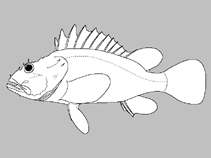
Vertèbres: 25. This species can be distinguished from its congeners by the following set of characters: P 17-19 (mode 18), middle rays branched; GR 19-22; pored lateral-line scales 2-5; GR 19-22 (20); small slit behind 4th gill arch; no palatine teeth; 2nd preopercular spine small; nuchal and parietal spines distinct; lateral lacrimal spine usually absent; suborbital spines 4-7; head width 14.7-16.9 (mean 15.4) % of SL [33.3-37.9 (35.6) % of HL]; snout length 9.9-11.0 (10.5) % of SL [23.2-25.9 (24.4) % of HL]; orbit diameter 13.4-16.1 (15.1) % of SL [31.0-37.3 (34.9) % of HL]; caudal-fin length 25.6-29.5 (27.6) % of SL; caudalpeduncle length 19.1-23.8 (20.6) % of SL. Colouration: head dark reddish-brown; body pinkish, with numerous tiny dark spots forming 4 faint brownish saddles and tiny blackish spots on abdomen and posterior part of caudal peduncle; all fins pinkish (except pectoral fin reddish); single black blotch on posterior area of spinous dorsal fin between 6th-10th spines (Ref. 128947).
Cross section: compressed.
Inhabits deep water habitats from depths of 228 to 990 m (Ref. 128947).
Cycle de vie et comportement reproducteur
Maturité | Reproduction | Frai | Œufs | Fécondité | Larves
Wibowo, K. and H. Motomura, 2022. Phenacoscorpius longicaudalis, a new species of scorpionfish (Teleostei: Scorpaenidae) from Western Australia, with first records of Phenacoscorpius adenensis from the southeastern Indian Ocean. Ichthyol. Res. 69:372-380. (Ref. 128947)
Statut dans la liste rouge de l'IUCN (Ref. 130435: Version 2025-2 (Global))
Menace pour l'homme
Harmless
Utilisations par l'homme
Outils
Articles particuliers
Télécharger en XML
Sources Internet
Estimations basées sur des modèles
Indice de diversité phylogénétique (Réf.
82804): PD
50 = 0.5020 [Uniqueness, from 0.5 = low to 2.0 = high].
Bayesian length-weight: a=0.01622 (0.00658 - 0.03999), b=3.07 (2.85 - 3.29), in cm total length, based on LWR estimates for this (Sub)family-body shape (Ref.
93245).
Niveau trophique (Réf.
69278): 3.5 ±0.6 se; based on size and trophs of closest relatives
Résilience (Réf.
120179): Haut, temps minimum de doublement de population inférieur à 15 mois (Preliminary K or Fecundity.).
Vulnérabilité de la pêche (Ref.
59153): Low vulnerability (10 of 100).
🛈