Classification / Noms
Noms communs | Synonymes | Catalog of Fishes(Genre, Espèce) | ITIS | CoL | WoRMS | Cloffa
Environnement : milieu / zone climatique / profondeur / gamme de distribution
Écologie
marin; eau douce; saumâtre démersal. Subtropical
Western Pacific: Japan and the Philippines.
Taille / Poids / Âge
Maturité: Lm ? range ? - ? cm
Max length : 5.6 cm SL mâle / non sexé; (Ref. 129074); 7.5 cm SL (female)
Description synthétique
Clés d'identification | Morphologie | Morphométrie
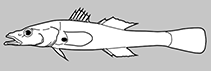
Épines dorsales (Total) : 7; Rayons mous dorsaux (Total) : 9 - 10; Épines anales: 1; Rayons mous anaux: 8. This species is distinguished from all other species of Butidae by a combination of the following characters: upper and lower jaws with enlarged canine teeth on their outermost rows; more canines on upper jaw (7-11) than on lower jaw (4-7); no inner row of canines in the posterior half of lower jaw; upper jaw does not extend to anterior margin of eye; interorbital sensory pore D paired with wide interval; the fourth transverse row of sensory papillae (4) crossed with longitudinal papilla row (b) on the cheek; longitudinal scales 88-100, transverse scales 32-36, predorsal scales 51-65, transverse scales at caudal peduncle 22 or 23, circumpeduncle scales 40-43; D VI-I, 9-10; A I,8; pectoral fin 17; predorsal length 38.4-40.7% of SL; body depth at anal-fin origin 14.6-17.1% of SL; eye diameter 3.3-5.1% of SL. Colouration: no distinct markings on the unpaired fins and caudal peduncle (Ref. 129074).
Cross section: oval.
This species is found in the tidal zone within or around mangroves in estuaries, and where four of the seven specimens were found hovering in small tidepools around the roots of mangrove trees [Bruguiera gymnorhiza (L.) Savigny] within the forest at night. The substrate of the tidepool was mud, and a thalassinid mud lobster, Thalassina anomala (Herbst, 1804) made a burrow system around the tidepool. Other fish species observed in that tidepool include Bostrychus sinensis, Eleotris melanosoma, Mugilogobius chulae, and Pisodonophis boro). One individual was found inside a polyvinyl chloride pipe buried in the muddy gravel bottom along the main course of the stream during the daytime, and this site was approximately 10 m from the mangrove. Another individual was collected from the burrow of an unknown builder on muddy substrate using a suction pump during the daytime. One juvenile specimen was found in a similar tidepool on Ishigaki Island, Japan. (Ref. 129074).
Cycle de vie et comportement reproducteur
Maturité | Reproduction | Frai | Œufs | Fécondité | Larves
Kobayashi, H., K. Nishigaki, T. Saeki and K. Maeda, 2023. First records of Paloa villadolidi from Japan with a redescription of Odonteleotris macrodon (Teleostei: Butidae). Species Diversity 28:165–175. (Ref. 129074)
Statut dans la liste rouge de l'IUCN (Ref. 130435: Version 2025-2 (Global))
Menace pour l'homme
Harmless
Utilisations par l'homme
Outils
Articles particuliers
Télécharger en XML
Sources Internet
Estimations basées sur des modèles
Indice de diversité phylogénétique (Réf.
82804): PD
50 = 0.7500 [Uniqueness, from 0.5 = low to 2.0 = high].
Bayesian length-weight: a=0.00933 (0.00414 - 0.02103), b=3.06 (2.86 - 3.26), in cm total length, based on LWR estimates for this (Sub)family-body shape (Ref.
93245).
Niveau trophique (Réf.
69278): 3.6 ±0.6 se; based on size and trophs of closest relatives
Résilience (Réf.
120179): Haut, temps minimum de doublement de population inférieur à 15 mois (Preliminary K or Fecundity.).
Vulnérabilité de la pêche (Ref.
59153): Low vulnerability (10 of 100).
🛈