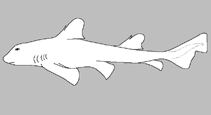
Elasmobranchii (haaien en roggen) (sharks and rays) >
Heterodontiformes (Bullhead and horn sharks) >
Heterodontidae (Bullhead, horn, or Port Jackson sharks)
Etymology: Heterodontus: heteros (Gr.), different; odontos (Gr.), tooth, referring to pointy teeth (for clutching prey) at front of jaws, different than rounded molar-like teeth (for grinding hard-shelled invertebrates) at the back (See ETYFish); marshallae: Named for Dr. Lindsay Marshall, scientific illustrator and elasmobranch scientist who expertly
painted all the sharks and rays of the world for the Chondrichthyan Tree of Life Project.
Milieu: milieu / Klimaatzone / Diepte / verspreidingsgebied
Ecologie
marien rifbewoner; diepte 125 - 229 m (Ref. 129794). Subtropical
Eastern Indian Ocean: Western Australia.
Grootte / Gewicht / Leeftijd
Maturiteit: Lm ? range ? - ? cm
Max length : 60.1 cm TL mannelijk / geslacht onbekend; (Ref. 129794)
Korte beschrijving
Determinatiesleutels | Morfologie | Morfometrie
This small species of hornshark is distinguished by the following set of characters: the colour
pattern consists of 22 dark bands and saddles; snout with a semicircular dark bar, often bifurcated for most of its length; without dark bar below posterior gill slits extending onto anterior pectoral fin; the anal fin is well separated from caudal fin (anal-caudal space 11.0-13.5% TL); ventral lobe of caudal fin is prominent (lower postventral margin 4.7-6.1% TL); dorsal spines are long with exposed first dorsal spine length 3.9-4.5% TL; dorsal fins are taller in juveniles than in adults; symphyseal and anterior teeth are pointed, lateral teeth molariform with a longitudinal keel; tooth files in upper jaw 20-22, in lower jaw 17-19; total vertebral centra 106-112, precaudal centra 70-76, monospondylous centra 33-37; egg case with narrow, curved, screw-like keels and with 1.5 rotations from anterior to posterior margins (Ref. 129794).
Cross section: angular.
Specimens ranged from 35.5-60.1 cm TL, an immature male at 43.2 cm TL and mature ones at 55.5-60.1 mm TL (Ref. 129794).
Levenscyclus en paargedrag
Maturiteit | Voortplanting | Paaien | Eieren | Fecunditeit | Larven
White, W.T., F.H. Mollen, H.L. O'Neill, L. Yang and G.J.P. Naylor, 2023. Species in disguise: A new species of Hornshark from northern Australia (Heterodontiformes: Heterodontidae). Diversity 15(849):1-27. (Ref. 129794)
Status op de Rode Lijst van het IUCN (Ref. 130435: Version 2025-2 (Global))
Gevaar voor de mens
Harmless
Gebruik door de mens
Tools
Speciale rapporten
Download XML
Internetbronnen
Schattingen op basis van modellen
Fylogenetische diversiteitsindex (Ref.
82804): PD
50 = 0.5029 [Uniqueness, from 0.5 = low to 2.0 = high].
Bayesian length-weight: a=0.00380 (0.00163 - 0.00884), b=3.15 (2.95 - 3.35), in cm total length, based on LWR estimates for this (Sub)family-body shape (Ref.
93245).
Trofisch niveau (Ref.
69278): 3.5 ±0.6 se; based on size and trophs of closest relatives
Weerstandsvermogen (Ref.
120179): Gemiddeld, minimale populatieverdubbelingstijd 1,4-4,4 jaar (Preliminary K or Fecundity.).
Kwetsbaarheid van de visserij (Ref.
59153): Moderate vulnerability (44 of 100).
🛈