Klassificering / Namn
Populärnamn | synonymer | Catalog of Fishes(Släkte, Arter) | ITIS | CoL | WoRMS | Cloffa
>
Characiformes (Characins) >
Characidae (Characins; tetras) > Aphyocharacinae
Etymology: Amazonichthys: Name from the Greek 'Amazon' (a race of warrior women) and 'ichthys' for fishes; referring to the indigenous Icamiabas that battled against Spanish troops led by Francisco Orellana in 1542 (who led an aggressive expedition into the Amazon region). The Icamiabas resembled the Amazons from Greek mythology, fighting with bows and arrows and forbidding the presence
of men inside their tribe (Medina, 1894); camelierae: Named for Dr. Priscila Camelier, an outstanding ichthyologist, passionate teacher, and strong
women’s rights activist; noun in the genitive case.
Miljö: miljö / Klimatzon / djupintervall / distributionsområde
Ekologi
; sötvatten bentopelagisk. Tropical
South America: Brazil.
Storlek / Vikt / Ålder
Könsmognad: Lm ? range ? - ? cm
Max length : 3.1 cm SL hane/ej könsbestämd; (Ref. 130247)
Kort beskrivning
Bestämningsnycklar | Morfologi | Morfometri
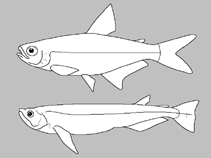
Mjukstrålar i ryggfenan (totalt) : 8 - 9; Mjukstrålar i analfenan: 25 - 30; Ryggkotor: 38 - 39. This species is distinguished from its congeners by the following characters: with anterior midlateral stripe reaching the caudal peduncle blotch (vs. stripe reaching the dorsal-fin region); proximal half of second unbranched dorsal-fin ray is densely pigmented (vs. hyaline or barely pigmented); caudal peduncle blotch round (vs. triangular); complete lateral line (vs. incomplete); higher number of longitudinal scales, 37-38 (vs. 31-33 in lindeae, 33-36 in lu); ventral margin of third infraorbital bone surpassing anterodorsal margin of preopercle (vs. usually reaching that point); precaudal vertebrae 13 (vs. 12); differs further from lu, by the dense concentration of dark brown chromatophores over the first unbranched dorsal and all unbranched anal-fin rays (vs. unbranched fin rays of both poorly pigmented); with two symmetrical conspicuous small dark blotches at the base of the caudal-fin rays (vs. usually absent, but when present, very diffuse); circumpeduncular scales 12 (vs. 10-11), and pectoral-fin rays i9-11 (vs. i8) (Ref. 130247).
Cross section: compressed.
Livscykel och parningsbeteende
Könsmognad | Reproduktion | Lek | Ägg | Fekunditet | Larver
Esguícero, A.L.H. and M.B. Mendonça, 2023. A new genus and two new species of tetras (Characiformes: Characidae), with a redescription and generic reassignment of Axelrodia lindeae Géry. Ichthyology & Herpetology 111(3):426-447. (Ref. 130247)
Status på IUCN:s rödlista (Ref. 130435: Version 2025-2 (Global))
Hot mot människor
Harmless
Mänskliga användningsområden
Fiskeri: saknar intresse
Verktyg
Särskilda rapporter
Ladda ner XML
Internet-källor
Uppskattningar baserade på modeller
Index för fylogenetisk mångfald (Ref.
82804): PD
50 = 0.6250 [Uniqueness, from 0.5 = low to 2.0 = high].
Bayesian length-weight: a=0.00692 (0.00283 - 0.01691), b=3.09 (2.88 - 3.30), in cm total length, based on LWR estimates for this (Sub)family-body shape (Ref.
93245).
Trofisk nivå (Ref.
69278): 3.2 ±0.4 se; based on size and trophs of closest relatives
Sårbarhet i fisket (Ref.
59153): Low vulnerability (10 of 100).
🛈