Classificazione / Nomi
Nomi Comuni | Sinonimi | Catalog of Fishes(Genere, Specie) | ITIS | CoL | WoRMS | Cloffa
>
Siluriformes (Catfishes) >
Pseudopimelodidae (Bumblebee catfishes, dwarf marbled catfishes) > Batrochoglaninae
Etymology: Microglanis: Greek, mikros = small + Greek, glanis = a fish that can eat the bait without touching the hook; a cat fish (Ref. 45335); sparsus: Name from Latin 'sparsus' meaning ‘sprayed’, referring to the mottled color pattern observed on this species; an adjective.
Ambiente: milieu / zona climatica / distribuzione batimetrica / gamma di distribuzione
Ecologia
; acqua dolce demersale. Tropical
South America: Brazil.
Dimensione / Peso / Età
Maturità: Lm ? range ? - ? cm
Max length : 2.3 cm SL maschio/sesso non determinato; (Ref. 130492)
Breve descrizione
Chiavi di identificazione | Morfologia | Morfometria
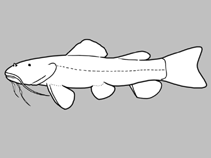
Raggi anali molli: 9 - 11. This species is distinguished from all its congeners by the following set of characters: lateral line short and not reaching vertical through last dorsal-fin ray, with only 5-7 pores; pectoral-fin spine generally with only retrorse serrations; anal-fin rays 9-11. Colouration: head and trunk are mottled with light and dark brown color; light transverse band on the occipital region is narrow, mottled brown, and poorly defined; dark brown saddles poorly defined on the nuchal, subdorsal, and subadipose regions; axis of gill filaments with a dark stripe. Further distinguished in having a smaller adipose fin base length 18.8-20.4% SL (vs. 20.4-31.8 in M. cibelae, M. cottoides, M. eurystoma, M. leptostriatus, M. minutus, M. nigripinnis, M. parahybae, M. pataxo, M. robustus); greater caudal peduncle length 15.7-17.6% SL (vs. 10.0-15.7 in M. carlae, M. cibelae, M. cottoides, M. eurystoma, M. iheringi, M. maculatus, M. malabarbai, M. nigripinnis, M. parahybae, M. pataxo, M. pellopterygius, M. poecilus, M. secundus, M. variegatus); and greater caudal-peduncle depth 13.1-14.7% SL (vs. 10.1-13.1 in M. carlae, M. cibelae, M. cottoides, M. eurystoma, M. iheringi, M. leptostriatus, M. malabarbai, M. minutus, M. reikoae, M. nigripinnis, M. parahybae, M. pataxo, M. pellopterygius, M. poecilus, M. secundus, M. variegatus) (Ref. 130492).
Cross section: oval.
Locality of collection has a well-preserved riparian forest, a river bed mainly muddy, with some sandy patches covered by organic matter, and abundant submerged leaf-litter. Stomach contents of two specimens examined included Ephemeroptera, Chironomidae larvae, and adult Diptera, denoting an insectivorous habit, typical for benthonic small catfish (Ref. 130492).
Ciclo vitale e comportamento di accoppiamento
Maturità | Riproduzione | Deposizione | Uova | Fecondità | Larve
Ruiz, W.B.G., 2016. Three new species of catfishes of the genus Microglanis from Brazil (Teleostei: Pseudopimelodidae), with comments on the characters used within the genus. Ichthyol. Explor. Freshwat. 27(3):211-232. [22 Nov. 2016 is the publication date without ZooBank registration, 18 Nov. with an electronic prepublication date; this serves as the date for Oct., Nov. and Dec.] (Ref. 130492)
Stato della Lista Rossa IUCN (Ref. 130435: Version 2025-2 (Global))
Minaccia per l'uomo
Harmless
Usi umani
Pesca: di nessun interesse
Strumenti
Rapporti speciali
Scarica XML
Fonti Internet
Stime basate su modelli
Indice di diversità filogenetica (Fonte Biblio.
82804): PD
50 = 0.5000 [Uniqueness, from 0.5 = low to 2.0 = high].
Bayesian length-weight: a=0.00692 (0.00292 - 0.01638), b=3.12 (2.91 - 3.33), in cm total length, based on LWR estimates for this (Sub)family-body shape (Ref.
93245).
Livello trofico (Fonte Biblio.
69278): 3.1 ±0.4 se; based on size and trophs of closest relatives
Vulnerabilità della pesca (Ref.
59153): Low vulnerability (10 of 100).
🛈