Classification / Noms
Noms communs | Synonymes | Catalog of Fishes(Genre, Espèce) | ITIS | CoL | WoRMS | Cloffa
>
Anguilliformes (Eels and morays) >
Ophichthidae (Snake eels) > Ophichthinae
Etymology: Ophichthus: Greek, ophis = serpent + Greek, ichthys = fish (Ref. 45335); naevius: Name from Latin 'naevius' meaning having moles or spots, referring to numerous dark spots on the dorsal surface of the body.
Environnement : milieu / zone climatique / profondeur / gamme de distribution
Écologie
marin récifal; profondeur 25 - 30 m (Ref. 130619). Tropical
Indian Ocean: Bay of Bengal, India.
Taille / Poids / Âge
Maturité: Lm ? range ? - ? cm
Max length : 37.8 cm TL mâle / non sexé; (Ref. 130619); 31.6 cm TL (female)
Description synthétique
Clés d'identification | Morphologie | Morphométrie
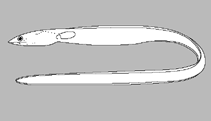
Vertèbres: 134 - 138. This moderately elongate species is distinguished from its congeners by the following set of characters: dorsal-fin origin just before pectoral-fin tip; pectoral fin rounded and longer than upper jaw; head 9.7%-10.8% TL; pre-anal length 40.0%-40.9% TL: tail 58.1%-60% TL; snout length 14.8%-18.3% HL; head pores: suprorbital 1 + 4, infraorbital 3 + 3, preopercular 3, mandibular 6; upper jaw no barbel; teeth uniserial small, conical, and pointed; intermaxillary with five teeth, 27-29 curved maxillary teeth on each side, 18 vomerine teeth in irregularly uniserial, 34 mandibular teeth; vertebrae: pre-dorsal 12-14; pre-anal 52-53; total 134-138. Colouration: dorsal body with numerous dense dark spots or patches, ventral body pale yellowish green, opercular mild yellow with no spots, and ventral portion of the lower jaw with distinct dark patches (Ref. 130619).
Cross section: oval.
Cycle de vie et comportement reproducteur
Maturité | Reproduction | Frai | Œufs | Fécondité | Larves
Kodeeswaran, P., A. Kathirvelpandian, A. Mohapatra, T.T.P.A. Kumar and U.K. Sarkar, 2023. A new snake eel species of the genus Ophichthus (Anguilliformes: Ophichthidae) from the southeast coast of India, Bay of Bengal, with the taxonomic account of Ophichthus chilkensis. J. Fish Biol. 104(3):737-745. (Ref. 130619)
Statut dans la liste rouge de l'IUCN (Ref. 130435: Version 2025-2 (Global))
Menace pour l'homme
Harmless
Utilisations par l'homme
Pêcheries: sans intérêt
Outils
Articles particuliers
Télécharger en XML
Sources Internet
Estimations basées sur des modèles
Indice de diversité phylogénétique (Réf.
82804): PD
50 = 0.5000 [Uniqueness, from 0.5 = low to 2.0 = high].
Bayesian length-weight: a=0.00093 (0.00041 - 0.00214), b=2.99 (2.79 - 3.19), in cm total length, based on LWR estimates for this (Sub)family-body shape (Ref.
93245).
Niveau trophique (Réf.
69278): 3.8 ±0.7 se; based on size and trophs of closest relatives
Résilience (Réf.
120179): Haut, temps minimum de doublement de population inférieur à 15 mois (Preliminary K or Fecundity.).
Vulnérabilité de la pêche (Ref.
59153): Low to moderate vulnerability (28 of 100).
🛈