Klassifizierung / Names
Namen | Synonyme | Catalog of Fishes(Gattung, Arten) | ITIS | CoL | WoRMS | Cloffa
>
Perciformes/Cottoidei (Sculpins) >
Liparidae (Snailfishes)
Etymology: Careproctus: Greek, kara = face + Greek, proktos = anus (Ref. 45335); staufferi: Named for Gary Stauffer, former Director of the RACE Division of the AFSC, and his recognition of the importance of systematic taxonomy to the ecosystem-based management of fisheries.
Umwelt: Milieu / Klimazone / Tiefenbereich / Verbreitungsgebiet
Ökologie
seewasser demersal; tiefenbereich 205 - 366 m (Ref. 129450). Temperate
North Pacific: Alaska (Aleutian Islands).
Größe / Gewicht / Alter
Geschlechtsreife: Lm ? range ? - ? cm
Max length : 9.0 cm SL Männchen/unbestimmt; (Ref. 129450)
Kurzbeschreibung
Bestimmungsschlüssel | Morphologie | Morphometrie
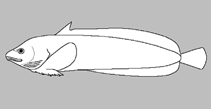
Rückenflossenweichstrahlen (insgesamt) : 40 - 42; Afterflossenweichstrahlen: 33 - 37; Wirbelzahl: 44 - 46. This species is distinguished from its congeners in the North Pacific by the following set of characters: broad rows of trilobed teeth on both the premaxilla and dentary; two chin pores in a single pit; low counts of median-fin rays, Dl 40-42, A 33-37 and vertebrae 44-46; and a moderately large pelvic disc, 33.3–47.9% HL; further differs by the pale peritoneum and stomach, and brick red body with golden slash along the anterior side of body; differs C. nelsoni by having two chin pores in a single pit (vs. two separate pores in C. nelsoni), a longer head 27.0-30.0 % SL (vs. 24.6–27.4 % SL), more pectoral-fin rays 36-44 \9vs. 32-37), and a distinct coloration in life, uniform red with scattered white speckles and a golden lateral slash (vs. no pale saddle across nape and golden slash); differs from C. mollis and C. sinensis by having fewer counts of the dorsal-fin rays 40-42 (vs. 53 in both species), anal-fin rays 33–37 (vs. 47), and vertebrae 44-46 (vs. 58-59), but a greater number of pectoral-fin rays 36-44 (vs. 33-35), and a larger pelvic disc 33.3-47.9 (vs. ca. 28 % HL) (Ref. 129450).
Cross section: oval.
Lebenszyklus und Paarungsverhalten
Geschlechtsreife | Fortpflanzung | Ablaichen | Eier | Fruchtbarkeit | Larven
Orr, J.W., 2016. Two new species of snailfishes of the genus Careproctus (Liparidae) from the Aleutian Islands, Alaska. Copeia 104(4):890-896. (Ref. 129450)
IUCN Rote Liste Status (Ref. 130435: Version 2025-2 (Global))
Bedrohung für Menschen
Harmless
Nutzung durch Menschen
Fischereien: nicht kommerziell
Tools
Zusatzinformationen
Download XML
Internet Quellen
Schätzungen auf der Grundlage von Modellen
Phylogenetischer Diversitätsindex (Ref.
82804): PD
50 = 0.5000 [Uniqueness, from 0.5 = low to 2.0 = high].
Bayesian length-weight: a=0.00447 (0.00203 - 0.00984), b=3.17 (2.99 - 3.35), in cm total length, based on LWR estimates for this Genus-body shape (Ref.
93245).
Trophische Ebene (Ref.
69278): 3.2 ±0.5 se; based on size and trophs of closest relatives
Widerstandsfähigkeit (Ref.
120179): hoch, Verdopplung der Population dauert weniger als 15 Monate. (Preliminary K or Fecundity.).
Anfälligkeit der Fischerei (Ref.
59153): Low vulnerability (10 of 100).
🛈