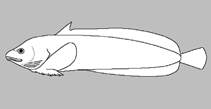
Classification / Noms
Noms communs | Synonymes | Catalog of Fishes(Genre, Espèce) | ITIS | CoL | WoRMS | Cloffa
>
Perciformes/Cottoidei (Sculpins) >
Liparidae (Snailfishes)
Etymology: Notoliparis: Greek, noton = back + Greek, liparos = fat (Ref. 45335); stewarti: Named for Andrew Stewart, collection Manager Sciences at Te Papa Tongarewa, the National
Museum of New Zealand.
Eponymy: Andrew Louis Stewart (d: 1958) is Collection Manager: Science (Fishes) at the Museum of New Zealand Te Papa Tongerewa. [...] (Ref. 128868), visit book page.
Environnement : milieu / zone climatique / profondeur / gamme de distribution
Écologie
marin bathydémersal; profondeur 6456 - 7560 m (Ref. 129455). Deep-water
Southwest Pacific: Kermadec Trench northeast of New Zealand.
Taille / Poids / Âge
Maturité: Lm ? range ? - ? cm
Max length : 28.2 cm SL mâle / non sexé; (Ref. 129455)
Description synthétique
Clés d'identification | Morphologie | Morphométrie
Rayons mous anaux: 46 - 50; Vertèbres: 59 - 64. This species is distinguished from Notoliparis kermadecensis in its well-defined lower pectoral-fin lobe 33.74% HL (vs. absent) and its 1:1 ratio of haemal spines to pterygiophores with one anal-fin ray and one pterygiophore for each haemal spine; generally with fewer vertebrae 59-64 (vs. 63-68), anal-fin rays 46-50 (vs. 49-54), pectoral-fin rays 29-34 (vs. 31-36), and caudal-fin rays 12-14 (vs. 13-15); with coronal pore and t1, t2 or t3, and t4 pores (vs. absent); differs from both N. kurchatovi and N. macquariensis in the numbers of vertebrae with more than 59 (vs. 50-58), pectoral-fin rays 29-34 (vs. 31), caudal-fin rays 12-14 (vs. 13), and head length 17-22% SL (vs. 24–25% SL), interorbital width 5-8% SL (vs. 8-9% SL), disk length 5-6% SL (vs. 9-10% SL), and gill opening length 23–35% HL (vs. 24-26% HL) (Ref. 129455).
Cross section: oval.
Cycle de vie et comportement reproducteur
Maturité | Reproduction | Frai | Œufs | Fécondité | Larves
Stein, D.L., 2016. Description of a new hadal Notoliparis from the Kermadec Trench, New Zealand, and redescription of Notoliparis kermadecensis (Nielsen) (Liparidae, Scorpaeniformes). Copeia 104(4):907-920. (Ref. 129455)
Statut dans la liste rouge de l'IUCN (Ref. 130435: Version 2025-2 (Global))
Menace pour l'homme
Harmless
Utilisations par l'homme
Pêcheries: sans intérêt
Outils
Articles particuliers
Télécharger en XML
Sources Internet
Estimations basées sur des modèles
Indice de diversité phylogénétique (Réf.
82804): PD
50 = 0.5312 [Uniqueness, from 0.5 = low to 2.0 = high].
Bayesian length-weight: a=0.00525 (0.00237 - 0.01161), b=3.15 (2.96 - 3.34), in cm total length, based on LWR estimates for this (Sub)family-body shape (Ref.
93245).
Niveau trophique (Réf.
69278): 3.6 ±0.6 se; based on size and trophs of closest relatives
Résilience (Réf.
120179): Milieu, temps minimum de doublement de population : 1,4 à 4,4 années (Preliminary K or Fecundity.).
Vulnérabilité de la pêche (Ref.
59153): Low vulnerability (24 of 100).
🛈