Taxonomic Remarks
The genus Pseudotrematomus is a synonym of Trematomus, which is confirmed by a molecular study to be published (J.-C. Hureau, pers. comm. 08 Jun. 2010).
Περιβάλλον: περιβάλλον / κλιματική ζώνη / εύρος βάθους / εύρος διανομής
Οικολογία
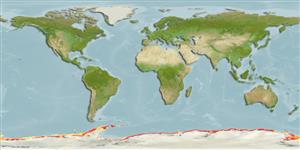
Θαλασσινό(ά) βενθικό(ς); εύρος βάθους 70 - 650 m (Ref. 26875). Polar; 60°S - 78°S
Southern Ocean: continental shelf of Antarctica and nearby islands, including the South Orkney.
Μήκος κατά την πρώτη ωρίμανση / Μέγεθος / Βάρος / Ηλικία
Γεννητική Ωρίμανση: Lm 22.0, range 19 - 26 cm
Max length : 34.5 cm TL αρσενικό/απροσδιόριστο; (Ref. 87549)
Ραχιαίες άκανθες (συνολικά) : 6 - 7; Μαλακές ραχιαίες ακτίνες (συνολικά) : 36 - 38; Εδρικές άκανθες: 0; Μαλακές εδρικές ακτίνες: 34 - 36; Σπόνδυλοι: 54 - 57. Second dorsal-fin rays 0-3 more than anal-fin rays. Preopercular-mandibular canal with 10 pores; infraorbital canal with 6-8 pores; supra-orbital canal with 4 pores; coronal commissure with a single median pore; temporal canal with 5-6 pores; supratemporal canal complete wit 3 pores. Body and head almost entirely scaled, including snout, preorbitals, posterior part of maxilla, lower jaw, isthmus, branchiostegal membranes and proximal parts of branchiostegal rays.
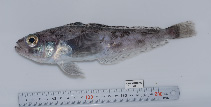
Color: In alcohol, ground color buff, with a chequered pattern formed by staggered dark blotches along the dorsal, lateral and ventral parts of the body; ventral dark blotches may appear as short wavy horizontal dark marks. Snout, occipital region and sometimes interorbital area are dark.
Body shape (shape guide): fusiform / normal.
Most common in shallower waters of the continental shelf, especially on banks less than 250 m deep in areas where local upwellings increase food supply (Ref. 6390). Juveniles are found near the surface, often in association with Antarctic krill (Euphausia superba) swarms. Feed on salps, nudibranchs, amphipods, copepods, polychaetes, krill, crustaceans, chaetognaths, and fish (Ref. 6390).
Mature females may spawn for the first time from around 7-9 years of age (Ref. 71843).
Dewitt, H.H., P.C. Heemstra and O. Gon, 1990. Nototheniidae. p. 279-331. In O. Gon and P.C. Heemstra (eds.) Fishes of the Southern Ocean. J.L.B. Smith Institute of Ichthyology, Grahamstown, South Africa. (Ref. 5179)
Κατάσταση Κόκκινου Καταλόγου IUCN (Ref. 130435: Version 2025-2 (Global))
Απειλή για τον άνθρωπο
Harmless
Ανθρώπινες χρήσεις
αλιεία: Εμπορικό(ά)
Εργαλεία
Ειδικές εκθέσεις
Λήψη XML
Διαδικτυακές πηγές
Εκτιμήσεις βάσει μοντέλων
Προτιμώμενη θερμοκρασία (Αναφ.
123201): -1.8 - 0.9, mean -0.9 °C (based on 436 cells).
Δείκτης φυλογενετικής ποικιλότητας (Αναφ.
82804): PD
50 = 0.5001 [Uniqueness, from 0.5 = low to 2.0 = high].
Bayesian length-weight: a=0.00490 (0.00334 - 0.00718), b=3.26 (3.14 - 3.38), in cm total length, based on LWR estimates for this species & Genus-body shape (Ref.
93245).
Τροφικό Επίπεδο (Αναφ.
69278): 3.4 ±0.1 se; based on diet studies.
Ελαστικότητα (Αναφ.
120179): Μεσαίο(α), ελάχιστος χρόνος για διπλασιασμό πληθυσμού 1,4 - 4,4 έτη (Fec = 1,400-12,854).
Ευπάθεια στην αλιεία (Ref.
59153): Moderate to high vulnerability (52 of 100).
🛈
Ευπάθεια στο κλίμα (Ref.
125649): High to very high vulnerability (66 of 100).
🛈
Θρεπτικά συστατικά (Ref.
124155): Calcium = 26.8 [16.2, 66.0] mg/100g; Iron = 0.498 [0.197, 0.983] mg/100g; Protein = 17.1 [16.1, 18.2] %; Omega3 = 0.384 [0.215, 0.659] g/100g; Selenium = 15.5 [6.7, 34.6] μg/100g; VitaminA = 22.2 [4.9, 102.6] μg/100g; Zinc = 0.473 [0.314, 0.718] mg/100g (wet weight); based on
nutrient studies.