Taxonomic Remarks
The genus Pseudotrematomus is a synonym of Trematomus, which is confirmed by a molecular study to be published (J.-C. Hureau, pers. comm. 08 Jun. 2010).
Milieu: milieu / Klimaatzone / Diepte / verspreidingsgebied
Ecologie
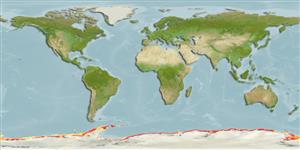
marien demersaal; diepte 70 - 650 m (Ref. 26875). Polar; 60°S - 78°S
Southern Ocean: continental shelf of Antarctica and nearby islands, including the South Orkney.
Lengte bij maturiteit / Grootte / Gewicht / Leeftijd
Maturiteit: Lm 22.0, range 19 - 26 cm
Max length : 34.5 cm TL mannelijk / geslacht onbekend; (Ref. 87549)
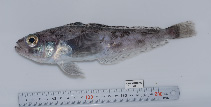
Dorsale stekels (totaal) : 6 - 7; Dorsale zachte stralen (totaal) : 36 - 38; Anale stekels: 0; Anale zachte stralen: 34 - 36; Wervels: 54 - 57. Second dorsal-fin rays 0-3 more than anal-fin rays. Preopercular-mandibular canal with 10 pores; infraorbital canal with 6-8 pores; supra-orbital canal with 4 pores; coronal commissure with a single median pore; temporal canal with 5-6 pores; supratemporal canal complete wit 3 pores. Body and head almost entirely scaled, including snout, preorbitals, posterior part of maxilla, lower jaw, isthmus, branchiostegal membranes and proximal parts of branchiostegal rays.
Color: In alcohol, ground color buff, with a chequered pattern formed by staggered dark blotches along the dorsal, lateral and ventral parts of the body; ventral dark blotches may appear as short wavy horizontal dark marks. Snout, occipital region and sometimes interorbital area are dark.
Body shape (shape guide): fusiform / normal.
Most common in shallower waters of the continental shelf, especially on banks less than 250 m deep in areas where local upwellings increase food supply (Ref. 6390). Juveniles are found near the surface, often in association with Antarctic krill (Euphausia superba) swarms. Feed on salps, nudibranchs, amphipods, copepods, polychaetes, krill, crustaceans, chaetognaths, and fish (Ref. 6390).
Mature females may spawn for the first time from around 7-9 years of age (Ref. 71843).
Dewitt, H.H., P.C. Heemstra and O. Gon, 1990. Nototheniidae. p. 279-331. In O. Gon and P.C. Heemstra (eds.) Fishes of the Southern Ocean. J.L.B. Smith Institute of Ichthyology, Grahamstown, South Africa. (Ref. 5179)
Status op de Rode Lijst van het IUCN (Ref. 130435: Version 2025-2 (Global))
Gevaar voor de mens
Harmless
Gebruik door de mens
Visserij: commercieel
Tools
Speciale rapporten
Download XML
Internetbronnen
Schattingen op basis van modellen
Gewenste temperatuur (Ref.
123201): -1.8 - 0.9, mean -0.9 °C (based on 436 cells).
Fylogenetische diversiteitsindex (Ref.
82804): PD
50 = 0.5001 [Uniqueness, from 0.5 = low to 2.0 = high].
Bayesian length-weight: a=0.00490 (0.00334 - 0.00718), b=3.26 (3.14 - 3.38), in cm total length, based on LWR estimates for this species & Genus-body shape (Ref.
93245).
Trofisch niveau (Ref.
69278): 3.4 ±0.1 se; based on diet studies.
Weerstandsvermogen (Ref.
120179): Gemiddeld, minimale populatieverdubbelingstijd 1,4-4,4 jaar (Fec = 1,400-12,854).
Kwetsbaarheid van de visserij (Ref.
59153): Moderate to high vulnerability (52 of 100).
🛈
Kwetsbaarheid voor het klimaat (Ref.
125649): High to very high vulnerability (66 of 100).
🛈
Voedingsstoffen (Ref.
124155): Calcium = 26.8 [16.2, 66.0] mg/100g; Iron = 0.498 [0.197, 0.983] mg/100g; Protein = 17.1 [16.1, 18.2] %; Omega3 = 0.384 [0.215, 0.659] g/100g; Selenium = 15.5 [6.7, 34.6] μg/100g; VitaminA = 22.2 [4.9, 102.6] μg/100g; Zinc = 0.473 [0.314, 0.718] mg/100g (wet weight); based on
nutrient studies.