Classification / Noms
Noms communs | Synonymes | Catalog of Fishes(Genre, Espèce) | ITIS | CoL | WoRMS | Cloffa
>
Perciformes/Serranoidei (Groupers) >
Serranidae (Sea basses: groupers and fairy basslets)
Etymology: Hypoplectrus: Greek, hypo = under + Greek, plektron = sting, spur (Ref. 45335); affinis: Name refers to the fact that this species is related but not identical to H. nigricans and H. chlorurus (which also applies to H. atlahua and H. randallorum which were not described at the time).
Environnement : milieu / zone climatique / profondeur / gamme de distribution
Écologie
marin récifal; profondeur 2 - 12 m (Ref. 125712). Tropical
Western Atlantic: Nicaragua, Mexico, Florida Keys, Grand Cayman, the Dominican Republic, Venezuela, Bonaire and Tobago.
Taille / Poids / Âge
Maturité: Lm ? range ? - ? cm
Max length : 9.1 cm SL mâle / non sexé; (Ref. 125712)
Description synthétique
Clés d'identification | Morphologie | Morphométrie
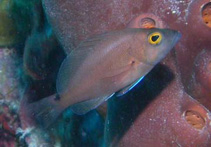
Épines dorsales (Total) : 10; Rayons mous dorsaux (Total) : 15; Épines anales: 3; Rayons mous anaux: 7; Vertèbres: 24. This species is distinguished from all named congeners by colouration by the following characters: body and dorsal fin are brown, no dark vertical bars, pelvic fins are bright smoky blue and anal fin ranges from smoky blue to brown with smoky blue tones; lips are smoky blue and the iris is yellow; most similarly coloured, unbarred hamlets are H. randallorum, H. chlorurus, H. nigricans, H. atlahua, which differ most from H. affinis in the ground colour of the body (lighter (tan) in H. randallorum which also has large dark spots on the caudal peduncle and snout) and darker (black) in H. chlorurus, H. nigricans, H. atlahua, plus H. chlorurus has yellow pectoral and caudal fins (Ref. 125712).
Cross section: compressed.
Found in reef areas, with its foraging behaviour suggesting that like the other hamlets, it is a mesopredator. In Bocas del Toro and Guna Yala (Panama), it has been observed at depths
ranging from 2 to 12 m.
Cycle de vie et comportement reproducteur
Maturité | Reproduction | Frai | Œufs | Fécondité | Larves
Puebla, O., F. Coulmace, C.J. Estapé and A.M. Estapé, 2022. A review of 263 years of taxonomic research on Hypoplectrus (Perciformes: Serranidae), with a redescription of Hypoplectrus affinis (Poey, 1861). Zootaxa 5093(2):101-141. (Ref. 125712)
Statut dans la liste rouge de l'IUCN (Ref. 130435: Version 2025-2 (Global))
Menace pour l'homme
Harmless
Utilisations par l'homme
Pêcheries: commercial
Outils
Articles particuliers
Télécharger en XML
Sources Internet
Estimations basées sur des modèles
Indice de diversité phylogénétique (Réf.
82804): PD
50 = 0.5000 [Uniqueness, from 0.5 = low to 2.0 = high].
Bayesian length-weight: a=0.01778 (0.00686 - 0.04609), b=3.03 (2.80 - 3.26), in cm total length, based on LWR estimates for this (Sub)family-body shape (Ref.
93245).
Niveau trophique (Réf.
69278): 3.7 ±0.4 se; based on size and trophs of closest relatives
Résilience (Réf.
120179): Haut, temps minimum de doublement de population inférieur à 15 mois (Preliminary K or Fecundity.).
Vulnérabilité de la pêche (Ref.
59153): Low vulnerability (10 of 100).
🛈