Classification / Noms
Noms communs | Synonymes | Catalog of Fishes(Genre, Espèce) | ITIS | CoL | WoRMS | Cloffa
>
Eupercaria/misc (Various families in series Eupercaria) >
Lutjanidae (Snappers) > Caesioninae
Etymology: Caesio: Latin, caesius, bluish-grey, 1835; it is the same name given to the silvery metal (Cs) (Ref. 45335); idreesi: Named for K.K. Idreesbabu, for his contributions to the field of marine biodiversity exploration and conservation in the Laccadive archipelago.
Environnement : milieu / zone climatique / profondeur / gamme de distribution
Écologie
marin pelagic-neritic; profondeur ? - 24 m (Ref. 130907). Tropical
Indian Ocean: India.
Taille / Poids / Âge
Maturité: Lm ? range ? - ? cm
Max length : 14.4 cm TL mâle / non sexé; (Ref. 130907)
Description synthétique
Clés d'identification | Morphologie | Morphométrie
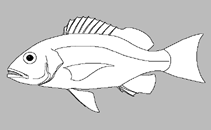
Épines dorsales (Total) : 10; Rayons mous dorsaux (Total) : 15 - 16; Épines anales: 3; Rayons mous anaux: 12. This species is distinguished from all its congeners by the following characters: with more lateral line scales 69 (vs. 51-67) and cheek scales 6-9 (vs. 3-5); differs from C. caerulaurea, C. varilineata by its confluent supratemporal scale band (vs. a V-shaped scale band); differs from C. striata by the greater number of anal-fin rays 12 (vs. 11), and from C. xanthalytos in the placement of supratemporal scale band, between the interorbital space (vs. below the interorbital space) and a yellow band passing through the lateral line (vs. passing above the lateral line) (Ref. 130907).
Cross section: compressed.
Cycle de vie et comportement reproducteur
Maturité | Reproduction | Frai | Œufs | Fécondité | Larves
Kar, C., P.C. Mariyambi, R. Raghavan and S. Sureshkumar, 2023. Mitochondrial phylogeny of fusilier fishes (family Caesionidae) from the Laccadive archipelago reveals a new species and two new records from the Central Indian Ocean. J, Fish Biol. 103(6):1445-1451. (Ref. 130907)
Statut dans la liste rouge de l'IUCN (Ref. 130435: Version 2025-2 (Global))
Menace pour l'homme
Harmless
Utilisations par l'homme
Pêcheries: d'intérêt potentiel
Outils
Articles particuliers
Télécharger en XML
Sources Internet
Estimations basées sur des modèles
Indice de diversité phylogénétique (Réf.
82804): PD
50 = 0.5010 [Uniqueness, from 0.5 = low to 2.0 = high].
Bayesian length-weight: a=0.01202 (0.00536 - 0.02697), b=3.07 (2.88 - 3.26), in cm total length, based on LWR estimates for this (Sub)family-body shape (Ref.
93245).
Niveau trophique (Réf.
69278): 3.3 ±0.4 se; based on size and trophs of closest relatives
Résilience (Réf.
120179): Haut, temps minimum de doublement de population inférieur à 15 mois (Preliminary K or Fecundity.).
Vulnérabilité de la pêche (Ref.
59153): Low vulnerability (10 of 100).
🛈