Classification / Noms
Noms communs | Synonymes | Catalog of Fishes(Genre, Espèce) | ITIS | CoL | WoRMS | Cloffa
Environnement : milieu / zone climatique / profondeur / gamme de distribution
Écologie
; eau douce benthopélagique. Tropical
Asia: India.
Taille / Poids / Âge
Maturité: Lm ? range ? - ? cm
Max length : 17.5 cm SL mâle / non sexé; (Ref. 130910)
Description synthétique
Clés d'identification | Morphologie | Morphométrie
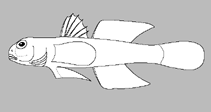
Épines dorsales (Total) : 7; Rayons mous dorsaux (Total) : 10; Épines anales: 1; Rayons mous anaux: 10. This species is distinguished by the following set of characters: body yellow, cylindrical with a large head (3.2-3.5 in SL); slender with body depth 4.5-6.3 in SL); much smaller eye
6.6-8.4 in HL; snout robust and long 2.0-2.6 in HL; mouth moderately protrusible; lower jaw smaller than upper one; teeth on upper jaw uniserial and that of lower jaw multiserial (2-3); predorsal scale rows 13-15; no scales on the preopercle and opercle; longitudinal scales series 55-58; gill rakers 2 + 1 + 6-7 on the first gill arch; cephalic sensory system interrupted with 8 pores, the first two of the oculoscapular pores at the posterior edge of the eye, the third near the preopercular edge, and the fourth and fifth are arranged together at the opercular edge (Ref. 130910).
Cross section: compressed.
Local communities have been consuming this species and holds a high commercial value, as they are sold at a high price in both fresh and dry forms. Considering its market value, possible extent of exploitation, and area of occurrence, it needs special conservation attention for sustainable utilization (Ref. 130910).
Cycle de vie et comportement reproducteur
Maturité | Reproduction | Frai | Œufs | Fécondité | Larves
Seth, J.K., S. Roy, S. Sura, D. Puvala, S.S. Mishra and A. Mohapatra, 2023. Description of a new species of the genus Awaous Valenciennes, 1837 (Gobiiformes: Oxudercidae) from the middle stretch of the Mahanadi River, Odisha, India, with comments on the Awaous species from India. J. Fish Biol.104(3):548-563. (Ref. 130910)
Statut dans la liste rouge de l'IUCN (Ref. 130435: Version 2025-2 (Global))
Menace pour l'homme
Harmless
Utilisations par l'homme
Pêcheries: hautement commercial
Outils
Articles particuliers
Télécharger en XML
Sources Internet
Estimations basées sur des modèles
Indice de diversité phylogénétique (Réf.
82804): PD
50 = 0.5000 [Uniqueness, from 0.5 = low to 2.0 = high].
Bayesian length-weight: a=0.00871 (0.00369 - 0.02053), b=3.07 (2.90 - 3.24), in cm total length, based on LWR estimates for this Genus-body shape (Ref.
93245).
Niveau trophique (Réf.
69278): 2.2 ±0.1 se; based on size and trophs of closest relatives
Résilience (Réf.
120179): Milieu, temps minimum de doublement de population : 1,4 à 4,4 années (Preliminary K or Fecundity.).
Vulnérabilité de la pêche (Ref.
59153): Low vulnerability (11 of 100).
🛈