Classification / Noms
Noms communs | Synonymes | Catalog of Fishes(Genre, Espèce) | ITIS | CoL | WoRMS | Cloffa
>
Gobiesociformes (Clingfishes) >
Gobiesocidae (Clingfishes and singleslits) > Diademichthyinae
Etymology: Rhinolepadichthys: The suffix 'rhino', meaning nose, in combination with the genus Lepadichthys, refers to the pointed snout in members of this genus, which distinguishes the new genus from Lepadichthys (sensu stricto); polyastrous: Name from combination of the New Greek 'polys' and 'astrous'” meaning 'many stars'” referring to
the many characteristic yellow dots on the body.
Environnement : milieu / zone climatique / profondeur / gamme de distribution
Écologie
marin récifal; profondeur 9 - 32 m (Ref. 130914). Tropical
Southwestern Indian Ocean: Mozambique and South Africa.
Taille / Poids / Âge
Maturité: Lm ? range ? - ? cm
Max length : 3.1 cm SL mâle / non sexé; (Ref. 130914)
Description synthétique
Clés d'identification | Morphologie | Morphométrie
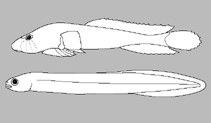
Rayons mous dorsaux (Total) : 10 - 11; Rayons mous anaux: 9. This species is distinguished from other members of the Lepadichthys lineatus.
complex by the following set of characters: body comparatively slender, its depth 10.8-14.9 (mean 13.1) % SL; adhesive disc elliptical, its length 17.0-20.6 (18.7) and width 11.6-13.9 (12.9) % SL, ratio of length to width 1.26-1.61; anus positioned somewhat anteriorly, the pre-anus length and disc to anus length 62.0-68.3 (65.8) and 21.6- 28.9 (25.8) % SL, respectively; snout tip is directed downward, usually horizontally level with lower margin of eye (lateral view); abdomen with a single yellow stripe along the ventral midline; dorsal and lateral surfaces of body with yellow dots, forming c. six to eight and three to five longitudinal rows, respectively (Ref. 129525),
Cross section: oval.
Partially digested crinoid pinnules were found in the stomach of a specimen suggesting a diet
of L. polyastrous similar to that of L. lineatus (Ref. 129525).
Cycle de vie et comportement reproducteur
Maturité | Reproduction | Frai | Œufs | Fécondité | Larves
Fujiwara, K. and H. Motomura, 2021. Review of the Lepadichthys lineatus complex (Gobiesocidae: Diademichthyinae) with descriptions of three new species. J. Fish Biol. 100(1):62-81. (Ref. 129525)
Statut dans la liste rouge de l'IUCN (Ref. 130435: Version 2025-2 (Global))
Menace pour l'homme
Harmless
Utilisations par l'homme
Outils
Articles particuliers
Télécharger en XML
Sources Internet
Estimations basées sur des modèles
Indice de diversité phylogénétique (Réf.
82804): PD
50 = 0.5625 [Uniqueness, from 0.5 = low to 2.0 = high].
Bayesian length-weight: a=0.00389 (0.00180 - 0.00842), b=3.12 (2.94 - 3.30), in cm total length, based on all LWR estimates for this body shape (Ref.
93245).
Niveau trophique (Réf.
69278): 3.4 ±0.2 se; based on size and trophs of closest relatives
Résilience (Réf.
120179): Haut, temps minimum de doublement de population inférieur à 15 mois (Preliminary K or Fecundity.).
Vulnérabilité de la pêche (Ref.
59153): Low vulnerability (10 of 100).
🛈