>
Tetraodontiformes (Puffers and filefishes) >
Tetraodontidae (Puffers) > Tetraodontinae
Etymology: Sphoeroides: Greek, sphaira = ball + Greek, suffix, oides = similar to (Ref. 45335); camila: Named for Camila Carvalho, one of the daughters of the first author of the new species; noun in apposition.
Milieu: milieu / Klimaatzone / Diepte / verspreidingsgebied
Ecologie
marien rifbewoner. Tropical
Southwestern Atlantic: Brazil, vagrants may occur in the Southern Caribbean.
Grootte / Gewicht / Leeftijd
Maturiteit: Lm ? range ? - ? cm
Max length : 14.0 cm SL mannelijk / geslacht onbekend; (Ref. 131040); common length : 10.0 cm TL mannelijk / geslacht onbekend; (Ref. 131040)
Korte beschrijving
Determinatiesleutels | Morfologie | Morfometrie
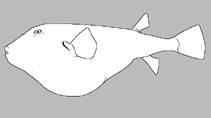
Dorsale zachte stralen (totaal) : 7 - 8; Anale zachte stralen: 6 - 8. This species is distinguished from its congeners by the following characters: D 7-8 (rarely 6); A 6-8, rarely 5 (unbranched rays 0-2, branched rays 4-6); pectoral-fin rays 13-14 (rarely 11, 12, 15, or 16), not including a rudimentary one on upper fin sheath; dorsal-fin rays 7–8 (rarely 6); dorsum with two pale lappets before opercle, none black; lappets on left sagittal section of body 24-34; lappets on head before opercle 1-8; adults no prickles on dorsum or sides of body (rarely a small patch after interorbital space), prickles occasionally present in juveniles from interorbital to middle back; very distinct row of black spots on ventrolateral body from chin to end of caudal-fin peduncle, the mid-ones vertically oblong, those on extremities rounded and considerably smaller; absence of black rounded spots above ventrolateral row; caudal fin with a dark bar at base and a very wide yellow-greenish bar posteriorly (Ref. 131040).
Cross section: angular.
This species is common in shallow, clear reef waters, up to 20 m deep along the Brazilian coast, and occasionally to 70 m depth; usually observed alone, in pairs or small groups, and often several individuals are found in a small area, hovering over the substrate. It rarely occurs in
seagrass beds. It is a generalist zoobenthivore, but frequently consumes zooplankton and drift material in the water column or at water surface. Diet is composed of crustaceans, molluscs, worms, echinoderms, and zooplankton larvae. Several individuals of this species were attracted to mussels opened by a diver, which indicates opportunistic foraging, a feature observed for several other pufferfish specie. An individual was observed following a hunting gold spotted eel Myrichthys ocellatus Lesueur, 1825 and snatching two small crabs flushed by the eel, which again demonstrates its opportunistic foraging. This species is diurnal, spending the night in reef crevices or partially buried on the adjacent sand/gravel bottom, with the eyes and upper dorsum exposed (Ref. 131040).
Levenscyclus en paargedrag
Maturiteit | Voortplanting | Paaien | Eieren | Fecunditeit | Larven
Araujo, G.S., Y.R Kurtz, I. Sazima, P.H. Carvalho, S.R. Floeter, A. Vilasboa, M.M. Rotundo, C.E.L. Ferreira, J.P. Barreiros, D.E. Pitassy and A. Carvalho-Filho, 2023. Evolutionary history, biogeography, and a new species of Sphoeroides a(Tetraodontiformes: Tetraodontidae): how the major biogeographic barriers of the Atlantic Ocean shaped the evolution of a pufferfish genus. Zool. J. of the Linnean Soc. 199(4):978-993. (Ref. 131040)
Status op de Rode Lijst van het IUCN (Ref. 130435: Version 2025-2 (Global))
Gevaar voor de mens
Harmless
Gebruik door de mens
Tools
Speciale rapporten
Download XML
Internetbronnen
Schattingen op basis van modellen
Fylogenetische diversiteitsindex (Ref.
82804): PD
50 = 0.5000 [Uniqueness, from 0.5 = low to 2.0 = high].
Bayesian length-weight: a=0.01660 (0.00743 - 0.03706), b=2.92 (2.74 - 3.10), in cm total length, based on LWR estimates for this (Sub)family-body shape (Ref.
93245).
Trofisch niveau (Ref.
69278): 3.4 ±0.4 se; based on size and trophs of closest relatives
Weerstandsvermogen (Ref.
120179): Hoog, minimale populatieverdubbelingstijd minder dan 15 maanden (Preliminary K or Fecundity.).
Kwetsbaarheid van de visserij (Ref.
59153): Low vulnerability (10 of 100).
🛈