Clasificación / Nombres
Nombres comunes | Sinónimos | Catalog of Fishes(Género, Especie) | ITIS | CoL | WoRMS | Cloffa
>
Gobiiformes (Gobies) >
Schindleriidae (Infantfishes)
Etymology: Schindleria: Named for ichthyologist Otto Schindler, 1906-1959 (Prof. Dr. Konrad Schindler, pers. comm Dec. 2017); nana: Name from Latin 'nanus’ for dwarf, referring to the small size of this species.
Eponymy: Otto Schindler (1906–1959) was an ichthyologist at Zoologische Staatssammlung München, Germany, where he was the first post-war Curator of Ichthyology (1949). [...] (Ref. 128868), visit book page.
Entorno: milieu / zona climática / rango de profundidad / gama de distribución
Ecología
marino asociado a arrecife; rango de profundidad 6 - 10 m (Ref. 131039). Tropical
Southwestern Pacific: Australia.
Tamaño / Peso / Edad
Madurez: Lm ? range ? - ? cm
Max length : 0.9 cm SL macho / no sexado; (Ref. 131039)
Descripción breve
Claves de identificación | Morfología | Morfometría
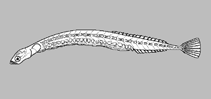
This new species is distinguished from its congeners by the following characters: a small-sized species (< 1.0 cm SL) in the long dorsal-fin type (LDF) species group and the first with only a few (4-7) and very large eggs (3.1-3.6% of SL); body elongated, slender, and not pigmented in preserved specimens; tail (postabdominal region) is distinctly shorter than abdomen; origin of the dorsal fin anterior to origin of the anal fin (LDF type); predorsal-fin length 63.1-63.5% of SL; preanal-fin length 71.2-73.0% of SL; body depth at the origin of the anal-fin 5.9-6.6% of SL; head length 14.4-15.6% of SL; head depth 7.8-8.1% of SL; eye diameter 3.3-3.6% of SL and 23.1-26.1% of the head length; pectoral radial plate length 5.6-5.8% of SL; maximum width of the pectoral radial plate 3.2-3.3% of SL and 56.9-57.1% of pectoral radial plate length; depth of the hypural late 66.7% of the urostyle length; D 16; A 13, the first anal-fin ray positioned below the 5-6th dorsal-fin ray; procurrent rays 6; swim-bladder not pigmented; premaxillary with continuous row of small, conical teeth, but zero teeth on the dentary of the holotype or five teeth (right) plus two isolated teeth (left) in the dentary of the paratype (Ref. 131039).
Cross section: compressed.
Ciclo vital y comportamiento de apareamiento
Madurez | Reproducción | Puesta | Huevos | Fecundidad | Larva
Ahnelt, H., O. Macek and V. Robitzch, 2024. Schindleria nana, a new extremely progenetic gobiid fish species (Teleostei: Gobiiformes: Gobiidae) from Lizard Island, Great Barrier Reef, Australia. J. Vert. Biol. 73(23112):1-17. (Ref. 131039)
Situación en la Lista Roja de la UICN (Ref. 130435: Version 2025-2 (Global))
Amenaza para el ser humano
Harmless
Usos humanos
Pesquerías: sin interés
Herramientas
Informes especiales
Descargar XML
Fuentes de Internet
Estimaciones basadas en modelos
Índice de diversidad filogenética (Referencia
82804): PD
50 = 0.5005 [Uniqueness, from 0.5 = low to 2.0 = high].
Bayesian length-weight: a=0.00389 (0.00180 - 0.00842), b=3.12 (2.94 - 3.30), in cm total length, based on all LWR estimates for this body shape (Ref.
93245).
Nivel trófico (Referencia
69278): 2.9 ±0.4 se; based on size and trophs of closest relatives
Vulnerabilidad pesquera (Ref.
59153): Low vulnerability (10 of 100).
🛈