>
Gobiiformes (Gobies) >
Gobiidae (Gobies) > Sicydiinae
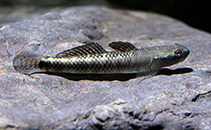
Etymology: Stiphodon: Greek, stiphos, -eos, -oys = mass + Greek, odous = teeth (Ref. 45335); chlorestes: Name from Latin 'chlorestes', a genus of hummingbirds, referring to this species often quickly flapping its pectoral fins in the mid-layer of water, like a hovering hummingbird. Also, the males have a metallic turquoise head and chartreuse body sides, similar to the plumage of the hummingbird Chlorestes cyanus; moun in apposition.
Milieu: milieu / Klimaatzone / Diepte / verspreidingsgebied
Ecologie
marien; zoet water; brak water demersaal; amfidroom. Tropical
Western Pacific: the Philippines and Taiwan.
Grootte / Gewicht / Leeftijd
Maturiteit: Lm ? range ? - ? cm
Max length : 4.0 cm SL mannelijk / geslacht onbekend; (Ref. 131349); 3.8 cm SL (female)
Korte beschrijving
Determinatiesleutels | Morfologie | Morfometrie
Dorsale stekels (totaal) : 7; Dorsale zachte stralen (totaal) : 9 - 10; Anale stekels: 1; Anale zachte stralen: 10 - 11. This species of the S. elegans group, is distinguished by the following: larger body size
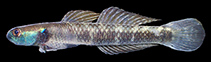
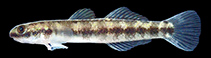
(maximum size > 4 cm (vs. the S. sapphirinus group) and pectoral-fin rays 15 (vs. 13-14); differs from other species of the S. elegans group by having wider interorbital width, males with occipital region almost naked, 7-8 oval bands or a black longitudinal band on lower body, with dorsal, anal, and caudal fins brown with white spots in males, a short red or orange line on posterior upper edge of caudal fin, pectoral fins with 3-8 rows of black and white spots in males and with one to two rows in females (Ref. 131349).
Cross section: oval.
This species prefers deep and fast-flowing water and cohabits with other Stiphodon species. The new species was found together with three other sicydiine species, including S. atropurpureus, S. percnopterygionus, and Sicyopterus longifilis; other common species are A. ocellaris and an unidentified species of Rhinogobius (Ref. 131349).
Levenscyclus en paargedrag
Maturiteit | Voortplanting | Paaien | Eieren | Fecunditeit | Larven
Jhuang, W.-C., A.C. Dimaquibo and T.-Y. Liao, 2024. Stiphodon chlorestes, a new species of sicydiine goby (Teleostei: Gobioidei) from Taiwan and Luzon. J. Fish Biol. 2024:1-16. (Ref. 131349)
Status op de Rode Lijst van het IUCN (Ref. 130435: Version 2025-2 (Global))
Gevaar voor de mens
Harmless
Gebruik door de mens
Visserij: van geen belang
Tools
Speciale rapporten
Download XML
Internetbronnen
Schattingen op basis van modellen
Fylogenetische diversiteitsindex (Ref.
82804): PD
50 = 0.5000 [Uniqueness, from 0.5 = low to 2.0 = high].
Bayesian length-weight: a=0.00389 (0.00180 - 0.00842), b=3.12 (2.94 - 3.30), in cm total length, based on all LWR estimates for this body shape (Ref.
93245).
Weerstandsvermogen (Ref.
120179): Hoog, minimale populatieverdubbelingstijd minder dan 15 maanden (Preliminary K or Fecundity.).
Kwetsbaarheid van de visserij (Ref.
59153): Low vulnerability (10 of 100).
🛈