Klassifizierung / Names
Namen | Synonyme | Catalog of Fishes(Gattung, Arten) | ITIS | CoL | WoRMS | Cloffa
>
Perciformes/Notothenioidei (Icefishes) >
Bathydraconidae (Antarctic dragonfishes) > Bathydraconinae
Etymology: Akarotaxis: Name from Greek words 'Akaros' meaning short or small and 'taxis' meaning row or line, referring to the short upper lateral line; gouldae: Named after the U.S. Antarctic Research and Supply Vessel (ARSV) Laurence M. Gould (LMG); Noun; feminine, following maritime tradition of referring to ships as female.
Umwelt: Milieu / Klimazone / Tiefenbereich / Verbreitungsgebiet
Ökologie
seewasser bathydemersal; tiefenbereich 215 - 964 m (Ref. 131869). Deep-water
Verbreitung
Territorien | FAO Gebiete | Ökosysteme | Vorkommen | Punkt Karte | Einführungen | Faunafri
Western Antarctic Peninsula.
Größe / Gewicht / Alter
Geschlechtsreife: Lm ? range ? - ? cm
Max length : 14.1 cm SL Männchen/unbestimmt; (Ref. 131869); 13.6 cm SL (female)
Kurzbeschreibung
Bestimmungsschlüssel | Morphologie | Morphometrie
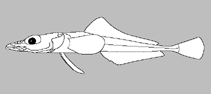
Rückenflossenweichstrahlen (insgesamt) : 28 - 31; Afterflossenweichstrahlen: 25 - 28; Wirbelzahl: 47 - 48. This species is distinguished from A. nudiceps by the presence of two dark vertical bands
of pigment on the body; a larger body depth at the origin of the anal fins; and a shorter snout and jaw length.The smallest adult specimen examined was 12.73 mm SL, although the sex was not determined. It is unknown when the characteristic dark vertical bands develop in this species, although it has been reported that these do not appear on larvae up to 2.07 cm SL (Ref. 131869).
Cross section: compressed.
Adults were captured at 600-705 m while larvae were captured at 215-964 m; habitats at these depths in coastal regions of Antarctica are likely composed of similar fine sediments (Ref. 131869).
Lebenszyklus und Paarungsverhalten
Geschlechtsreife | Fortpflanzung | Ablaichen | Eier | Fruchtbarkeit | Larven
Corso, A.D., T. Desvignes, J.R. McDowell, C.-H.C. Cheng, E.E. Biesack, D.K. Steinberg and E.J. Hilton, 2024. Akarotaxis gouldae, a new species of Antarctic dragonfish (Notothenioidei: Bathydraconidae) from the western Antarctic Peninsula. Zootaxa 5501(2):265-290. (Ref. 131869)
IUCN Rote Liste Status (Ref. 130435: Version 2025-2 (Global))
Bedrohung für Menschen
Harmless
Nutzung durch Menschen
Tools
Zusatzinformationen
Download XML
Internet Quellen
Schätzungen auf der Grundlage von Modellen
Phylogenetischer Diversitätsindex (Ref.
82804): PD
50 = 0.7500 [Uniqueness, from 0.5 = low to 2.0 = high].
Bayesian length-weight: a=0.00224 (0.00117 - 0.00427), b=3.25 (3.08 - 3.42), in cm total length, based on LWR estimates for this (Sub)family-body shape (Ref.
93245).
Trophische Ebene (Ref.
69278): 3.5 ±0.4 se; based on size and trophs of closest relatives
Widerstandsfähigkeit (Ref.
120179): mittel, Verdopplung der Population dauert 1,4 - 4,4 Jahre. (Preliminary K or Fecundity.).
Anfälligkeit der Fischerei (Ref.
59153): Low vulnerability (10 of 100).
🛈