Klassifizierung / Names
Namen | Synonyme | Catalog of Fishes(Gattung, Arten) | ITIS | CoL | WoRMS | Cloffa
>
Siluriformes (Catfishes) >
Sisoridae (Sisorid catfishes) > Sisorinae
Etymology: Glyptothorax: Greek, glyptes = carver + Greek, thorax = breast (Ref. 45335); vatandousti: Named for Saber Vatandoust (Qaemshahr), for his contributions to the taxonomy of fishes in Iran and an ichthyology professor of the first author, AJR, at the Azad Islamic University of Babol; noun in genitive, indeclinable.
Umwelt: Milieu / Klimazone / Tiefenbereich / Verbreitungsgebiet
Ökologie
; süßwasser demersal. Subtropical
Asia: Iran.
Größe / Gewicht / Alter
Geschlechtsreife: Lm ? range ? - ? cm
Max length : 9.1 cm SL Männchen/unbestimmt; (Ref. 129017)
Kurzbeschreibung
Bestimmungsschlüssel | Morphologie | Morphometrie
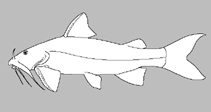
This species is distinguished from its congeners in the Persian Gulf basin by the following characters: flank with a fine, pale-brown mottled pattern overlaid by small and large, blackish or dark-brown blotches; a deep caudal-peduncle, its depth 1.1-1.3 times in length; length of thoracic adhesive apparatus 0.8-1.1 in width; roundish anterior end of medial pit; none or with a pale-brown triangle-shaped blotch in front of dorsal-fin origin (Ref. 129017).
Cross section: oval.
This species was only found in shallow and slow-moving streams. The Kangavar stream, where this species was found in abundance, has a relatively narrow width of around 1.5 meters, clear water with a rubble bed, and moderately fast current, and it is facing serious threats due to human activities. Water from the Kangavar and Gamasiab is used for irrigation in nearby agricultural farms, which can significantly alter the water flow and quality, leading to habitat degredation and the frequent passage of trucks and other vehicles near the Kangavar result in soil erosion and sedimentation, which can negatively impact the species’ survival and reproduction (Ref. 129017).
Lebenszyklus und Paarungsverhalten
Geschlechtsreife | Fortpflanzung | Ablaichen | Eier | Fruchtbarkeit | Larven
Jouladeh-Roudbar, A., H.R. Ghanavi and J. Freyhof, 2023. Glyptothorax vatandousti, a new species of torrent catfish from the upper Karkheh drainage in Iran (Teleostei: Sisoridae). Zootaxa 5315(1):037-058. (Ref. 129017)
IUCN Rote Liste Status (Ref. 130435: Version 2025-2 (Global))
Bedrohung für Menschen
Harmless
Nutzung durch Menschen
Tools
Zusatzinformationen
Download XML
Internet Quellen
Schätzungen auf der Grundlage von Modellen
Phylogenetischer Diversitätsindex (Ref.
82804): PD
50 = 0.5000 [Uniqueness, from 0.5 = low to 2.0 = high].
Bayesian length-weight: a=0.00794 (0.00365 - 0.01726), b=3.02 (2.85 - 3.19), in cm total length, based on LWR estimates for this Genus-body shape (Ref.
93245).
Trophische Ebene (Ref.
69278): 3.2 ±0.4 se; based on size and trophs of closest relatives
Widerstandsfähigkeit (Ref.
120179): mittel, Verdopplung der Population dauert 1,4 - 4,4 Jahre. (Preliminary K or Fecundity.).
Anfälligkeit der Fischerei (Ref.
59153): Low vulnerability (10 of 100).
🛈