Classification / Noms
Noms communs | Synonymes | Catalog of Fishes(Genre, Espèce) | ITIS | CoL | WoRMS | Cloffa
>
Perciformes/Zoarcoidei (Eelpouts and pricklebacks) >
Zoarcidae (Eelpouts) > Gymnelinae
Etymology: Krusensterniella: Named after the Russian navigator explorer, Admiral I.F. Krusenstern, who led the first Russian circumnavigation (1803– 1806) and visited that part of the Sea of Okhotsk where the type species was found. Of the two Russian-language names 'krusensterniella' (Taranets, 1937) and 'kruzenshternia' (Sheiko and Fedorov, 2000)—the first one has come into scientific use (Ref. 130195); kurilensis: Named after its type locality, the Kuril Islands.
Environnement : milieu / zone climatique / profondeur / gamme de distribution
Écologie
marin démersal; profondeur ? - 142 m (Ref. 130195). Temperate
Northwest Pacific: off the southern Kuril Islands.
Taille / Poids / Âge
Maturité: Lm ? range ? - ? cm
Max length : 9.9 cm TL mâle / non sexé; (Ref. 130195)
Description synthétique
Clés d'identification | Morphologie | Morphométrie
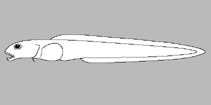
Rayons mous anaux: 90; Vertèbres: 110. This species is distinguished by the following characters: pungent spines in dorsal fin X, terminating noticeably anterior to the middle of the caudal part of the body and are associated with caudal vertebrae 12-21; all spiny rays (D1 + D2) 40; ray number in D1 are twice less than in D3: 30 and 66 ; vertebrae 110; D 106 (30 X 66); A 90; scale cover well developed and reach ahead to the middle of the pectoral fins (Ref. 130195).
Cross section: compressed.
Cycle de vie et comportement reproducteur
Maturité | Reproduction | Frai | Œufs | Fécondité | Larves
Chernova, N.V., 2022. Review of prickled eelpouts of genus Krusensterniella (Zoarcidae) describing three new species from the far-eastern seas. J. Ichthyol. 62(2):153-172. (Ref. 130195)
Statut dans la liste rouge de l'IUCN (Ref. 130435: Version 2025-2 (Global))
Menace pour l'homme
Harmless
Utilisations par l'homme
Pêcheries: sans intérêt
Outils
Articles particuliers
Télécharger en XML
Sources Internet
Estimations basées sur des modèles
Indice de diversité phylogénétique (Réf.
82804): PD
50 = 0.5039 [Uniqueness, from 0.5 = low to 2.0 = high].
Bayesian length-weight: a=0.00324 (0.00135 - 0.00773), b=3.15 (2.94 - 3.36), in cm total length, based on LWR estimates for this (Sub)family-body shape (Ref.
93245).
Niveau trophique (Réf.
69278): 3.1 ±0.4 se; based on size and trophs of closest relatives
Résilience (Réf.
120179): Haut, temps minimum de doublement de population inférieur à 15 mois (Preliminary K or Fecundity.).
Vulnérabilité de la pêche (Ref.
59153): Low vulnerability (10 of 100).
🛈