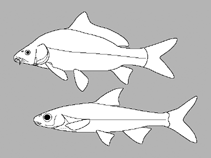
Classificazione / Nomi
Nomi Comuni | Sinonimi | Catalog of Fishes(Genere, Specie) | ITIS | CoL | WoRMS | Cloffa
>
Cypriniformes (Carps) >
Cyprinidae (Minnows or carps) > Smiliogastrinae
Etymology: Enteromius: Greek, enteron = intestine + Greek, myo, mys = muscle (Ref. 45335); gamo: Named after the Gamo people, who inhabit the region around Lake Abaya where the holotype was collected; noun in apposition.
Ambiente: milieu / zona climatica / distribuzione batimetrica / gamma di distribuzione
Ecologia
; acqua dolce benthopelagico. Tropical
Africa: Ethiopia.
Dimensione / Peso / Età
Maturità: Lm ? range ? - ? cm
Max length : 4.5 cm SL maschio/sesso non determinato; (Ref. 132497)
Breve descrizione
Chiavi di identificazione | Morfologia | Morfometria
This species belongs to a phenotypic group which is distinguished by the following characters: thickened and serrated last unbranched dorsal fin ray, a low number of scales in the lateral series (? 27), and a yellow, orange or reddish blotch on operculum; differs from E. kerstenii and all congeners from Tanzania, Kenya, and Uganda by short anterior (15.8-35.1% of snout length, not reaching anterior margin of the eye) and posterior (63.2-95.7% of snout length, extending between the middle of the eye and the posterior margin of the eye) barbels; differs further by a short predorsal length, 49.6-56.3 % of SL, short pelvic-fin length, 16.9-20.7% of SL, not reaching to anal-fin origin; short pectoral-fin length, 17.4-21.2% of SL, not reaching to pelvic-fin origin; branched pectoral-fin rays 14-15; circumpeduncular scales 11; serrae 10-19 on posterior margin of last unbranched dorsal fin ray (Ref. 132497).
Cross section: oval.
Occurs where substrate composition was dominated by silt and sand. The altitude of the sampling sites ranged from 1,122 m a.s.l. (5°53’31’’N, 37°29’44’’E) to 1,185 m a.s.l. (6°3’35’’N, 37°36’2’’E). Stomach contents examined (N = 3) contained unidentifiable fine organic detritus, remains of aquatic (Chironomidae, Ephemeroptera) and terrestrial (Formicidae) arthropods, and some non-organic material (sand grains). In the sampling sites, this species was found sympatric with Enteromius cf. stigmatopygus (Ref. 132497).
Ciclo vitale e comportamento di accoppiamento
Maturità | Riproduzione | Deposizione | Uova | Fecondità | Larve
Englmaier, G.K., M. Chai, A. Wubie, R.A. Collins and A. Getahun, 2024. A new species within the Enteromius kerstenii complex (Actinopterygii, Cyprinidae, Smiliogastrinae) from south-western Ethiopia. Zootaxa 5512(2):166-184. (Ref. 132497)
Stato della Lista Rossa IUCN (Ref. 130435: Version 2025-2 (Global))
Minaccia per l'uomo
Harmless
Usi umani
Strumenti
Rapporti speciali
Scarica XML
Fonti Internet
Stime basate su modelli
Indice di diversità filogenetica (Fonte Biblio.
82804): PD
50 = 0.5000 [Uniqueness, from 0.5 = low to 2.0 = high].
Bayesian length-weight: a=0.00603 (0.00282 - 0.01286), b=3.06 (2.87 - 3.25), in cm total length, based on LWR estimates for this (Sub)family-body shape (Ref.
93245).
Livello trofico (Fonte Biblio.
69278): 3.0 ±0.3 se; based on size and trophs of closest relatives
Resilienza (Fonte Biblio.
120179): Alto, tempo minimo di raddoppiamento della popolazione meno di 15 mesi (Preliminary K or Fecundity.).
Vulnerabilità della pesca (Ref.
59153): Low vulnerability (10 of 100).
🛈