Classification / Noms
Noms communs | Synonymes | Catalog of Fishes(Genre, Espèce) | ITIS | CoL | WoRMS | Cloffa
>
Blenniiformes (Blennies) >
Clinidae (Clinids)
Etymology: Heteroclinus: Greek, heteros = other + Greek, klinein, kline = sloping and bed, due to the four apophyses of sphenoid bone (Ref. 45335); colemani: 'colemani', i.e. named for Neville Coleman (Ref. 132458).
Environnement : milieu / zone climatique / profondeur / gamme de distribution
Écologie
marin benthopélagique; profondeur 0 - 15 m (Ref. 132458). Subtropical
Indo-West Pacific: Australia
Taille / Poids / Âge
Maturité: Lm ? range ? - ? cm
Max length : 4.7 cm SL (female)
Description synthétique
Clés d'identification | Morphologie | Morphométrie
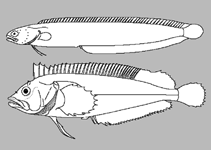
Épines dorsales (Total) : 27 - 28; Rayons mous dorsaux (Total) : 3; Épines anales: 2; Rayons mous anaux: 18 - 19. This specis is distinguished by the following characters: D III, XXIV-XXV, 3; A II,18-19; pectoral rays 13, uppermost ray very short and easily missed; gill rakers on outer face of first arch 3 + 7-8 = 10-11; circumorbital head pores uniserial (13-17 pores); orbital tentacle is elongated with a rounded lobe, expanding slightly distally; nasal tentacle simple, round, its flap length about equal to tubular base length; middle gill rakers and uppermost rakers on the outer face of first arch not branched dorsally; first dorsal fin elevated in both sexes (second dorsal spine 11.6-16.7% SL, not showing significant change with size), fin originating over posterior end of eye to about middle of preoperculum; third dorsal spine in front of a vertical from pelvic origin; last dorsal ray is connected by membrane to posterior part of caudal peduncle; body deep with proportion increasing with increasing size (depth at anal origin 25.9-30.6% SL in 3.67-5.0 cm SL and 30.3-34.6% SL in specimens 5.1-8.3 cm SL). Colouration: body usually red to reddish orange in life; 6-7 dark saddles along dorsolateral surface of the trunk and tail extending onto dorsal fin, with 6-8 clear windows between spines, no spines in windows; windows sometimes incomplete, with pigment above and or below clear parts of windows; three silver to white bars with brown margins radiating from the eye, the first across snout and middle of upper jaw, the second extending ventrally to end of mouth, the third extending posteriorly from mid posterior edge of eye (Ref. 132458).
Cross section: compressed.
Depth and maximum size based on original description.
Cycle de vie et comportement reproducteur
Maturité | Reproduction | Frai | Œufs | Fécondité | Larves
Hoese, D.F., A. Hay and J.D. Dibattista, 2024. A review of the Heteroclinus heptaeolus complex (Pisces: Blennioidei: Clinidae), with three new species and discussion of use of proportions in taxonomic studies. Zootaxa 5432(3):301-348. (Ref. 132458)
Statut dans la liste rouge de l'IUCN (Ref. 130435: Version 2025-2 (Global))
Menace pour l'homme
Harmless
Utilisations par l'homme
Pêcheries: sans intérêt
Outils
Articles particuliers
Télécharger en XML
Sources Internet
Estimations basées sur des modèles
Indice de diversité phylogénétique (Réf.
82804): PD
50 = 0.5000 [Uniqueness, from 0.5 = low to 2.0 = high].
Bayesian length-weight: a=0.00501 (0.00221 - 0.01134), b=3.06 (2.86 - 3.26), in cm total length, based on LWR estimates for this (Sub)family-body shape (Ref.
93245).
Niveau trophique (Réf.
69278): 3.3 ±0.5 se; based on size and trophs of closest relatives
Résilience (Réf.
120179): Haut, temps minimum de doublement de population inférieur à 15 mois (Preliminary K or Fecundity.).
Vulnérabilité de la pêche (Ref.
59153): Low vulnerability (10 of 100).
🛈