>
Clupeiformes (Herrings) >
Dussumieriidae (Round herrings)
Etymology: Dussumieria: In honor of Dussumier, a collaborator of Cuvier, who sent him collections of fishes from the Indian Ocean (Ref. 45335); chimaera: Name 'chimaera' refers to the characteristics of this species including deep body, scales with striae or pores, and counts of pectoral-fin rays with melanophores, vertebrae, and longitudinal series scale
rows.
Eponymy: Jean-Jacques Dussumier (1792–1883) was a French merchant, collector, traveller and ship owner. [...] (Ref. 128868), visit book page.
Entorno: milieu / zona climática / rango de profundidad / gama de distribución
Ecología
marino pelagic-neritic. Tropical
Distribución
Territorios | Áreas FAO | Ecosistemas | Ocurrencias, apariciones | Mapa de puntos | Introducciones | Faunafri
Western Pacific: Fiji.
Tamaño / Peso / Edad
Madurez: Lm ? range ? - ? cm
Max length : 11.3 cm SL macho / no sexado; (Ref. 132601)
Descripción breve
Claves de identificación | Morfología | Morfometría
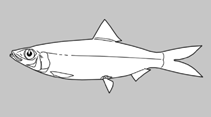
Radios blandos dorsales (total) : 15 - 17; Radios blandos anales: 12 - 14; Vértebra: 55 - 56. This species is distinguished by the following set of characters: (first gill arch Upper/Lower Gill Rakers and Total) 1UGR 13-16 (modally 14), 1LGR 28-30 (29), 1TGR 42-45 (42); (second gill arch) 2UGR 10 or 11 (11), 2LGR 24-26 (25), 2TGR 34-37 (35); (third gill arch) 3UGR 8-10 (9), 3LGR 16-18 (17), 3TGR 24-27 (27); (fourth gill arch) 4UGR 4 or 5 (5), 4 LGR 10 or 11 (11), 4TGR 14-16 (16); branchiostegal rays 13-15 (14); scale rows in longitudinal series 52-55 (53); vertebrae 55 or 56 (56); pseudobranchial filaments 18-21 (18); lateral scales no posterior striae; melanophores scattered on first to fourth uppermost pectoral-fin rays; parasphenoid and vomer toothless; each palatine with 1 or 2 rows of conical teeth, small conical teeth distributed sparsely on pterygoids; body deep, its depth 22.1-23.8% (mean 22.8%) of SL; pre-dorsal-fin length 54.5-56.0% of SL; pre-pelvic-fin length 58.4-60.9% of SL; dorsal-fin base long, 14.0-15.6% of SL; caudal peduncle is deep 8.8-9.6% of SL; (distance from dorsal-fin origin to pectoral-fin insertion) D-P1 32.9-34.9% of SL; (distance from dorsal-fin origin to pelvic-fin insertion) D-P2 21.8-23.7% of SL; (distance between dorsal- and anal-fin origins) D-A 31.9-33.7% of SL; (distance between pectoral- and pelvic-fin insertions) P1-P2 31.5-33.7% of SL; (distance from pelvic-fin insertion to anal-fin origin) P2-A 20.1-21.8% of SL; pectoral fin 15.1-16.4% of SL; pelvic fin is long, 10.2-11.0% of SL; pelvic-fin insertion is just below origin of 9th to 12th dorsal-fin ray; maxilla 8.3-9.1% of SL; lower jaw is short, 12.7-13.6% of SL (Ref. 132601).
Cross section: compressed.
Ciclo vital y comportamiento de apareamiento
Madurez | Reproducción | Puesta | Huevos | Fecundidad | Larva
Hata, H., 2023. A new species of rainbow sardine, Dussumieria chimaera (Clupeiformes: Dussumieriidae) from Fiji. Ichthyol. Res. 71(1):154-162. (Ref. 132601)
Situación en la Lista Roja de la UICN (Ref. 130435: Version 2025-2 (Global))
Amenaza para el ser humano
Harmless
Usos humanos
Pesquerías: comercial
Herramientas
Informes especiales
Descargar XML
Fuentes de Internet
Estimaciones basadas en modelos
Índice de diversidad filogenética (Referencia
82804): PD
50 = 0.5020 [Uniqueness, from 0.5 = low to 2.0 = high].
Bayesian length-weight: a=0.00933 (0.00426 - 0.02047), b=3.03 (2.84 - 3.22), in cm total length, based on LWR estimates for this (Sub)family-body shape (Ref.
93245).
Nivel trófico (Referencia
69278): 3.4 ±0.4 se; based on size and trophs of closest relatives
Resiliencia (Referencia
120179): Alto, población duplicada en un tiempo mínimo inferior a 15 meses (Preliminary K or Fecundity.).
Vulnerabilidad pesquera (Ref.
59153): Low vulnerability (10 of 100).
🛈