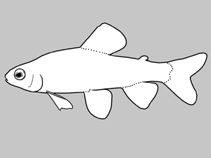
Classification / Noms
Noms communs | Synonymes | Catalog of Fishes(Genre, Espèce) | ITIS | CoL | WoRMS | Cloffa
>
Characiformes (Characins) >
Crenuchidae (South American darters) > Characidiinae
Etymology: Characidium: Diminutive of Charax, -akos = a fish without identification (Ref. 45335); itarare: Name 'itarare' from the tupi word meaning 'stone carved by the water', in allusion to the underground rivers in the region. Also in reference to the type locality of the species, Rio Itararé basin. Noun in apposition.
Environnement : milieu / zone climatique / profondeur / gamme de distribution
Écologie
; eau douce benthopélagique. Tropical
South America: Brazil.
Taille / Poids / Âge
Maturité: Lm ? range ? - ? cm
Max length : 5.3 cm mâle / non sexé; (Ref. 133152)
Description synthétique
Clés d'identification | Morphologie | Morphométrie
Rayons mous dorsaux (Total) : 8 - 9; Rayons mous anaux: 6. This species is distinguished from its congeners by the following set of characters: scaled isthmus; secondary bars absent; dark-brown, vertically elongated middorsal blotches that lack pigmentation in their central region, appearing diamond-like (larger specimens) and diamond-like blotches, vertically elongated and fully pigmented (smaller specimens); black chromatophores in caudal fin; roundish black marks on the pelvic absent, dorsal and anal fins; tricuspid dentary teeth present; peduncular blotch absent; white gap between posterior edge of the opercle and the humeral blotch absent; longitudinal stripe in the mid-lateral region of body ending in peduncle caudal; pre-orbital stripe present; area between pelvic fin and origin of anal fin straight in lateral view (Ref. 133152).
Body shape (shape guide): elongated; Cross section: compressed.
This species is found in steams with clear water and substrate composed of sand and small pebbles (Ref. 133152).
Cycle de vie et comportement reproducteur
Maturité | Reproduction | Frai | Œufs | Fécondité | Larves
Stabile, B.H.M., R.B. dos Reis, A. Frota, W.J. da Graça and A.V. de Oliveira, 2024. Morphology and molecular evidence of a new species of Characidium (Characiformes: Crenuchidae) from the edges of a protected area at Rio Itararé, upper Rio Paraná, southern Brazil. J. Fish Biol. 105:1850-1861. (Ref. 133152)
Statut dans la liste rouge de l'IUCN (Ref. 130435: Version 2025-2 (Global))
Menace pour l'homme
Harmless
Utilisations par l'homme
Pêcheries: sans intérêt
Outils
Articles particuliers
Télécharger en XML
Sources Internet
Estimations basées sur des modèles
Indice de diversité phylogénétique (Réf.
82804): PD
50 = 0.5000 [Uniqueness, from 0.5 = low to 2.0 = high].
Bayesian length-weight: a=0.01023 (0.00452 - 0.02316), b=3.07 (2.89 - 3.25), in cm total length, based on LWR estimates for this Genus-body shape (Ref.
93245).
Niveau trophique (Réf.
69278): 3.5 ±0.3 se; based on size and trophs of closest relatives
Vulnérabilité de la pêche (Ref.
59153): Low vulnerability (10 of 100).
🛈