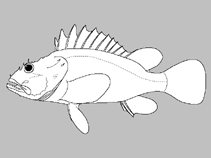
>
Perciformes/Scorpaenoidei (Scorpionfishes) >
Scorpaenidae (Scorpionfishes or rockfishes) > Scorpaeninae
Etymology: Neomerinthe: Greek, neos = new + Greek, merinthos, -ou = thread (Ref. 45335); costata: Name 'costata from the Latin word 'costa', meaning 'rib', referring to thedistinct longitudinal ridge on the lateral surface of the maxilla.
Lingkungan: lingkungan / zona iklim / kisaran kedalaman / jangkauan distribusi
Ekologi
laut dasar (demersal); kisaran kedalaman 100 - 253 m (Ref. 133153). Tropical
Eastern Indian Oceam: Australia.
Ukuran / Berat / umur
Kematangan: Lm ? range ? - ? cm
Max length : 8.4 cm SL jantan/; (Ref. 133153)
deskripsi pendek
Kunci identifiaksi (pengenalan) | Morfologi | Morfometrik
Duri punggung (Keseluruhan (total)) : 12; duri punggung lunak (Keseluruhan (total)) : 8 - 9. This species is distinguished by the following set of characters: dorsal-fin rays 8 or 9 (usually 9); pectoral-fin rays 18 or 19 (19); scale rows in longitudinal series 36-38 (38); pored lateral-line scales 24; scale rows above lateral line 4 or 5 (5), below lateral line 9 or 10 (10), between 6th dorsal-fin spine base and lateral line 5 or 6 (5), and between last dorsal-fin spine base and lateral line 5 or 6 (5); upper gill rakers 5 or 6 (5), lower gill rakers 10-13 (12) [8-10 (9) and 2-4 (3) on ceratohyal and hypobranchial, respectively], total gill rakers 15-18 (18); presence of longitudinal ridge on lateral surface of maxilla; presence of lateral lacrimal spine; 3 suborbital spines; presence of 2nd preopercular spine; 4th preopercular spine small, directed posteroventrally; upper posttemporal spine usually present; minute slit behind last gill arch; many small cycloid scales on base of pectoral fin and ventral surface of body from isthmus to beyond pelvic fin; posterior margin of soft-rayed portion of dorsal-fin rounded; fin membrane between last dorsal-fin soft ray and caudal peduncle present; 2nd dorsal-fin ray length 18.6-20.8 (19.5) % SL; 3rd dorsal-fin ray length 19.1-20.4 (19.6) % SL; 4th dorsal-fin ray length 18.0-20.5 (19.1) % SL; 5th dorsal-fin ray length 17.6-20.3 (18.6) % SL; 3rd preopercular spine length 1.3-3.0 (2.2) % HL; 4th preopercular spine length 0.7-2.0 (1.2) % HL; pale yellowish body and pectoral fins, with indistinct blotches above lateral line when preserved (Ref. 133153).
Cross section: compressed.
Siklus hidup dan perilaku kawin
Kematangan | Reproduksi, perkembang biakan | Pemijahan | telur-telur | Fekunditas | Larva
Matsumoto, T. and H. Motomura, 2024. Two new species of the scorpionfish genus Neomerinthe Fowler 1935 (Teleostei: Scorpaenidae) from northwestern Australia. Ichthyological Research 72(1):1-16. (Ref. 133153)
Status IUCN Red List (Ref. 130435: Version 2025-2 (Global))
ancaman kepada manusia
Harmless
penggunaan manusia
Perikanan: tidak ada kepentingan
Alat, peralatan
laporan khas
muat turun XML
Sumber internet
Estimasi berdasarkan model
Indeks keanekaragaman filogenetik (Acuan
82804): PD
50 = 0.5000 [Uniqueness, from 0.5 = low to 2.0 = high].
Bayesian length-weight: a=0.01288 (0.00626 - 0.02652), b=3.02 (2.85 - 3.19), in cm total length, based on LWR estimates for this (Sub)family-body shape (Ref.
93245).
Tingkat Trofik (Acuan
69278): 3.5 ±0.6 se; based on size and trophs of closest relatives
Daya lenting (Acuan
120179): Tinggi, Waktu penggandaan populasi minimum kurang dari 15 bulan (Preliminary K or Fecundity.).
Kerentanan Penangkapan Ikan (Ref.
59153): Low vulnerability (10 of 100).
🛈