Classification / Noms
Noms communs | Synonymes | Catalog of Fishes(Genre, Espèce) | ITIS | CoL | WoRMS | Cloffa
>
Siluriformes (Catfishes) >
Loricariidae (Armored catfishes) > Hypostominae
Etymology: Chaetostoma: Greek, chaite = hair + Greek, stoma = mouth (Ref. 45335); sacramento: Name 'Chaetostoma sacramento' from the type locality of the species, Pampa de Sacramento.
Environnement : milieu / zone climatique / profondeur / gamme de distribution
Écologie
; eau douce démersal. Tropical
South America: Peru.
Taille / Poids / Âge
Maturité: Lm ? range ? - ? cm
Max length : 7.9 cm SL mâle / non sexé; (Ref. 133161)
Description synthétique
Clés d'identification | Morphologie | Morphométrie
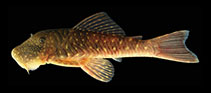
This species is distinguished from its congeners by the following set of characters: distinct, white, variably-shaped spots or vermiculations ½-2× nostril diameter on grey to brown background on the head; highly variable, small to large distinct white spots, vermiculations or bands on the body; adipose fin fully formed; uniformly brown adipose fin; golden spots across the dorsal fin rays; eight branched dorsal-fin rays; curved cheek odontodes; two predorsal plates; presence of excrescence; pelvic-fin insertion slightly posterior of dorsal-fin insertion (Ref. 133161).
Cross section: oval.
Cycle de vie et comportement reproducteur
Maturité | Reproduction | Frai | Œufs | Fécondité | Larves
Meza-Vargas, V., J.L. Ramirez and N.K. Lujan, 2024. The ornate rubbernose pleco (Siluriformes, Loricariidae, Chaetostoma), a new species from the Ucayali River Basin, Peru. Zoosyst. Evol. 100 (4):1387-1400. (Ref. 133161)
Statut dans la liste rouge de l'IUCN (Ref. 130435: Version 2025-2 (Global))
Menace pour l'homme
Harmless
Utilisations par l'homme
Pêcheries: sans intérêt
Outils
Articles particuliers
Télécharger en XML
Sources Internet
Estimations basées sur des modèles
Indice de diversité phylogénétique (Réf.
82804): PD
50 = 0.5000 [Uniqueness, from 0.5 = low to 2.0 = high].
Bayesian length-weight: a=0.01660 (0.00737 - 0.03739), b=2.95 (2.77 - 3.13), in cm total length, based on LWR estimates for this Genus-body shape (Ref.
93245).
Résilience (Réf.
120179): Haut, temps minimum de doublement de population inférieur à 15 mois (Preliminary K or Fecundity.).
Vulnérabilité de la pêche (Ref.
59153): Low vulnerability (10 of 100).
🛈