Classificatie / Namen
Lokale namen | Synoniemen | Catalog of Fishes(Genus, Soort(en)) | ITIS | CoL | WoRMS | Cloffa
>
Siluriformes (Catfishes) >
Heptapteridae (Three-barbeled catfishes)
Etymology: Pimelodella: Diminutive latinized of greek, pimele = fat + Greek, odous, odella = little teeth (Ref. 45335); guato: Name 'guato' in honor of the indigenous Guató people who historically inhabited the type locality.
Milieu: milieu / Klimaatzone / Diepte / verspreidingsgebied
Ecologie
; zoet water demersaal. Tropical
South America: Brazil.
Grootte / Gewicht / Leeftijd
Maturiteit: Lm ? range ? - ? cm
Max length : 12.8 cm SL mannelijk / geslacht onbekend; (Ref. 132465)
Korte beschrijving
Determinatiesleutels | Morfologie | Morfometrie
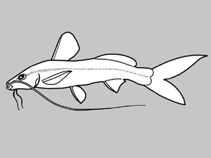
Dorsale stekels (totaal) : 2; Dorsale zachte stralen (totaal) : 6; Anale zachte stralen: 7 - 8; Wervels: 41 - 42. This species is distinguished by the following set of characters: long maxillary barbel, reaching at least the anal-fin terminus when parallel to main body axis; supraoccipital process reaching the anterior nuchal plate; robust dorsal-fin spine, bearing small, straight spinules along three-fourths of its posterior margin; 41–42 (rarely 43 or 44) total vertebrae; body slightly darkened, dorsal fin with light brown stripe near its origin, followed by a hyaline stripe, and distal half dark and by the dorsal lamina of the Weberian apparatus reaching the ventral margin of the supraoccipital process only at its first third; preoperculomandibular laterosensory canal openings at dentary not particularly large; brown midlateral stripe wide and dorsal lamina of the Weberian apparatus reaching the ventral margin of the supraoccipital process only at its first third; posterior margin of pectoral-fin spine bearing 13-23 large, retrorse blades along basal two-thirds; adipose fin 2.5 to 3.0 times in SL; epiphyseal branch of supraorbital canal on the head (S6) emerging as a single pore (Ref. 132465).
Body shape (shape guide): elongated; Cross section: oval.
The species inhabits shallow, moderately flowing waters with sandy substrate. They are observed to be abundant during the rainy season and is easy to catch at night (Ref. 132465).
Levenscyclus en paargedrag
Maturiteit | Voortplanting | Paaien | Eieren | Fecunditeit | Larven
Pierre, V. and V. Slobodian, 2024. A new species of Pimelodella (Siluriformes: Heptapteridae) from the Paraguai basin, Brazil, with a discussion regarding its distribution. Neotrop. Ichthyol. 2024; 22(1):e230110. (Ref. 132465)
Status op de Rode Lijst van het IUCN (Ref. 130435: Version 2025-2 (Global))
Gevaar voor de mens
Harmless
Gebruik door de mens
Visserij: van geen belang
Tools
Speciale rapporten
Download XML
Internetbronnen
Schattingen op basis van modellen
Fylogenetische diversiteitsindex (Ref.
82804): PD
50 = 0.5000 [Uniqueness, from 0.5 = low to 2.0 = high].
Bayesian length-weight: a=0.00851 (0.00399 - 0.01817), b=2.96 (2.79 - 3.13), in cm total length, based on LWR estimates for this Genus-body shape (Ref.
93245).
Trofisch niveau (Ref.
69278): 3.6 ±0.5 se; based on size and trophs of closest relatives
Weerstandsvermogen (Ref.
120179): Gemiddeld, minimale populatieverdubbelingstijd 1,4-4,4 jaar (Preliminary K or Fecundity.).
Kwetsbaarheid van de visserij (Ref.
59153): Low vulnerability (10 of 100).
🛈