>
Perciformes/Uranoscopoidei (Sand dwellers) >
Pinguipedidae (Sandperches)
Etymology: Parapercis: Greek, para = the side of + Greek, perke = perch (Ref. 45335); imamurai: Named after Dr. Hisashi Imamura, Japan, in honour of his valuable contributions to the taxonomy
of pinguipedid fishes.
Eponymy: Dr Hisashi Imamura is a Japanese ichthyologist who has, for some years (since 2009), been Associate Professor of the Fisheries Science faculty at the Hokkaido University Museum, Hakodate, which institution awarded his PhD. [...] (Ref. 128868), visit book page.
Môi trường: môi trường / vùng khí hậu / Mức độ sâu / phạm vi phân phối
Sinh thái học
biển gần đáy; mức độ sâu 256 - 405 m (Ref. 117414). Tropical
Sự phân bố
Lãnh thổ | Các khu vực của FAO | Các hệ sinh thái | Những lần xuất hiện | Bản đồ điểm | Những chỉ dẫn | Faunafri
West Pacific: Australia.
Bộ gần gũi / Khối lượng (Trọng lượng) / Tuổi
Chín muồi sinh dục: Lm ? range ? - ? cm
Max length : 20.8 cm SL con đực/không giới tính; (Ref. 117414)
Mô tả ngắn gọn
Khóa để định loại | Hình thái học | Sinh trắc học
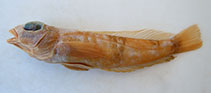
Các tia vây lưng cứng (tổng cộng) : 5; Các vây lưng mềm (tổng cộng) : 21; Tia cứng vây hậu môn: 1; Tia mềm vây hậu môn: 17; Động vật có xương sống: 29. This species is distinguished by the following characters: D V,21, fifth dorsal-fin spine longest; ; A I,17; pectoral-fin rays 19-20 (usually 19); lateral-line scales 55-58 (modally 57); gill rakers 5-7 + 11-12 = 16-18 (modally 17); ctenoid predorsal scales 10-12, extending forward to or just anterior to vertical from upper corner of preopercle; ctenoid scales on cheek, except for some small cycloid scales anteriorly near lower margin of suborbital region, extending forward to tip of maxilla in adults, slightly further forward in juveniles; canine teeth 10 in outer row at front of lower jaw; vomer in adults with 3 rows of robust conical teeth (2 rows in some juveniles); no palatine teeth; hind margin of preopercle usually entire, angle with 2-4 low blunt serrations in adults, and more robust pointed spines in some juveniles; angle of subopercle with single broad, flattened spine; vertebrae, abdominal 10; caudal 19; adults with pelvic fins reaching vent, slightly beyond vent in juveniles. Colouration: pale brownish pink, with broad diffuse dusky bar from lower margin of eye across the suborbital region, three broad diffuse dusky bands across the body and caudal-fin base, the first on soft dorsal fin below base of dorsal-fin rays 6-11, second below base of dorsal-fin rays 15-19, third from posterior portion of caudal peduncle extending onto caudal-fin base; bands are distinct in juveniles, becoming more faint with growth; juveniles with large black blotch in lower half of soft dorsal fin between rays 6-9 and 16-18; anal fin black, the pigmentation on fins reducing with growth, faint or absent in large specimen (Ref. 117414).
Body shape (shape guide): elongated; Cross section: oval.
Collected from soft to rubbly bottom by demersal trawl, at depths of 256-405 m (Ref. 117414).
Vòng đời và hành vi giao phối
Chín muồi sinh dục | Sự tái sinh sản | Đẻ trứng | Các trứng | Sự sinh sản | Ấu trùng
Johnson, J.W. and J.W. Wilmer, 2018. Three new species of Parapercis (Perciformes: Pinguipedidae) and first records of P. muronis (Tanaka, 1918) and P. rubromaculata Ho, Chang & Shao, 2012 from Australia. Zootaxa 4388(2). (Ref. 117414)
Tình trạng Sách đỏ IUCN (Ref. 130435: Version 2025-2 (Global))
Mối đe dọa đối với con người
Harmless
Sử dụng của con người
Các nghề cá: không ích lợi (thú vị)
Các công cụ
Báo cáo đặc biệt
Tải xuống XML
Các nguồn internet
Ước tính dựa trên mô hình
Chỉ số đa dạng phát sinh loài (Tài liệu tham khảo
82804): PD
50 = 0.5000 [Uniqueness, from 0.5 = low to 2.0 = high].
Bayesian length-weight: a=0.00692 (0.00314 - 0.01524), b=3.06 (2.88 - 3.24), in cm total length, based on LWR estimates for this Genus-body shape (Ref.
93245).
Mức dinh dưỡng (Tài liệu tham khảo
69278): 3.6 ±0.4 se; based on size and trophs of closest relatives
Thích nghi nhanh (Tài liệu tham khảo
120179): Trung bình, thời gian nhân đôi của chủng quần tối thiểu là 1.4 - 4.4 năm (Preliminary K or Fecundity.).
Sự dễ bị tổn thương của nghề đánh cá (Ref.
59153): Low vulnerability (15 of 100).
🛈