>
Cichliformes (Cichlids, convict blennies) >
Cichlidae (Cichlids) > Cichlinae
Etymology: Aequidens: Latin, aequus, equal, equally + Latin, dens, dentis = teeth (Ref. 45335); pirilampo: Name 'pirilampo' from a Portuguese word meaning 'firefly', in reference to the color pattern of the species, similar to the bioluminescent Coleoptera that is common in the region. Noun in apposition.
Lingkungan: lingkungan / zona iklim / kisaran kedalaman / jangkauan distribusi
Ekologi
; air tawar bentopelagis. Tropical
South America: Brazil.
Ukuran / Berat / umur
Kematangan: Lm ? range ? - ? cm
Max length : 9.5 cm SL jantan/; (Ref. 133465)
deskripsi pendek
Kunci identifiaksi (pengenalan) | Morfologi | Morfometrik
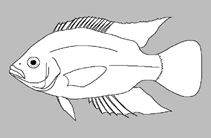
Duri punggung (Keseluruhan (total)) : 14 - 15; duri punggung lunak (Keseluruhan (total)) : 9 - 11. This species is distinguished from its congeners by the following set of characters: anteriorly oblique dark brown flank bars; dorsal head contour, from the tip of the snout to the vertical through the posterior margin of the eye, almost straight, except for a conspicuous concavity at the interorbital region; lower jaw 40.2-46.9% HL and 16.7-18.5% SL; upper jaw, 12.2-15.1% SL; discontinuous lateral band in fixed specimens; lateral band divided into blotches more conspicuous at the encounter with flank bars; unpigmented areas anteriorly and posteriorly to the midlateral spot absent, not forming a whitish circle above the longitudinal stripe; dorsal portion of the flank bar 5 anteriorly inclined and less conspicuous than the midlateral spot; eight flank bars (1a, 1p, 2, 3, 4, 5, 6, and 7); lateral band equally conspicuous along its entire length; dark-brown blotch dorsal to midlateral spot absent; cheek spot present, not spanning the entire anterior margin of the vertical arm of the preopercle; iridescent vermiculations on the cheek, opercle and pectoral girdle absent; suborbital stripe not retained in adult specimens; large, dark-brown blotches on the cheek and opercle and by the brown lachrymal region absent; preopercular spot absent; round midlateral spot; posterodorsal blotch on the flank absent (133465).
Body shape (shape guide): fusiform / normal; Cross section: compressed.
The new species inhabits lentic mesohabitats, typically between 10 cm (for hatchlings) and slightly more than 1 meter deep. These are further characterized by extremely crystalline water, with submerged vegatation (Ref. 133465).
Siklus hidup dan perilaku kawin
Kematangan | Reproduksi, perkembang biakan | Pemijahan | telur-telur | Fekunditas | Larva
Oliveira, R.C.D., L.F.C. Tencatt, G.D.C. Depra, R. Britzke, C. Oliveira and W.J. da Graça, 2024. A new species of Aequidens (Cichliformes: Cichlidae) from the rio Paraguai basin, Brazil. Neotropical Ichthyology 22(2):e230106. (Ref. 133465)
Status IUCN Red List (Ref. 130435: Version 2025-2 (Global))
ancaman kepada manusia
Harmless
penggunaan manusia
Perikanan: tidak ada kepentingan
Alat, peralatan
laporan khas
muat turun XML
Sumber internet
Estimasi berdasarkan model
Indeks keanekaragaman filogenetik (Acuan
82804): PD
50 = 0.5000 [Uniqueness, from 0.5 = low to 2.0 = high].
Bayesian length-weight: a=0.01445 (0.00665 - 0.03141), b=3.08 (2.90 - 3.26), in cm total length, based on LWR estimates for this (Sub)family-body shape (Ref.
93245).
Tingkat Trofik (Acuan
69278): 3.2 ±0.5 se; based on size and trophs of closest relatives
Daya lenting (Acuan
120179): Tinggi, Waktu penggandaan populasi minimum kurang dari 15 bulan (Preliminary K or Fecundity.).
Kerentanan Penangkapan Ikan (Ref.
59153): Low vulnerability (10 of 100).
🛈