Lingkungan: lingkungan / zona iklim / kisaran kedalaman / jangkauan distribusi
Ekologi
laut dasar (demersal); kisaran kedalaman 110 - 282 m (Ref. 123372). Deep-water
Northwest Pacific: Sea of Okhotsk.
Ukuran / Berat / umur
Kematangan: Lm ? range ? - ? cm
Max length : 9.9 cm TL jantan/; (Ref. 123372)
deskripsi pendek
Kunci identifiaksi (pengenalan) | Morfologi | Morfometrik
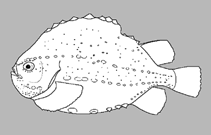
Duri punggung (Keseluruhan (total)) : 8; duri punggung lunak (Keseluruhan (total)) : 12 - 13; Sirip dubur lunak: 11 - 12; vertebrata, bertulang belakang: 28 - 31. This species is distinguished by the following characters: first dorsal fin, immersed in thick skin, is triangular (acute-angled in the posterior part), it retains its mobility (it can be pressed against the body); bony plaques on the head (individuals 4.0-8.5 cm SL) are small, arranged at intervals, form no more than five longitudinal rows in the interorbital region, while are more often single-row on the cheeks; anus area with only four large plaques; number of plaques on the body and head (circumpectoral, postbranchial, postorbital, median, supraorbital, and interorbital rows) 21-33 (average 26.7); distance from anus to the beginning of anal fin is 15-19% SL on average; pectoral fin long, on average, 53-66% HL. Colouration: when alive, head and upper side of body pigmented, with the dark, indistinct, somewhat elongated spots are located mainly near the bone plaques; belly and disk are light; chin dark; some specimens have scattered small spots on
the belly, front of the anus in the form of dashes and in the form of very small dots behind it; caudal peduncle with a dark stripe; D2 rays with dark elongated small spots; caudal rays with vague spots; peritoneum light (Ref. 123372).
Body shape (shape guide): short and / or deep; Cross section: circular.
This species is more common on silty or sandy-stony bottom sediments at low temperatures (-1.2 to -1.3°C), which makes it possible to attribute it to the group of glacial-Okhotsk-Sea species. It does not occur in shallow waters with depths of less than 110 m, a habitat with a supercooled water mass with negative temperatures. Summer spawning is assumed with a 7.9 cm TL female with mature eggs (4-5 mm, 148 eggs) caught in July (adult females caught in May have immature eggs) (Ref. 123372).
Siklus hidup dan perilaku kawin
Kematangan | Reproduksi, perkembang biakan | Pemijahan | telur-telur | Fekunditas | Larva
Chernova, N.V., O.S. Voskoboinikova, O.Yu. Kudryavtseva, S.Yu. Orlova, O.A. Maznikova and A.M. Orlov, 2019. Taxonomic status of the Okhotsk lumpsucker Eumicrotremus ochotonensis (Cyclopteridae, Cottoidei) with redescription of E. derjugini. J. Ichthyol. 59(3):289-306. (Ref. 123372)
Status IUCN Red List (Ref. 130435: Version 2025-2 (Global))
ancaman kepada manusia
Harmless
penggunaan manusia
Perikanan: tidak ada kepentingan
Alat, peralatan
laporan khas
muat turun XML
Sumber internet
Estimasi berdasarkan model
Indeks keanekaragaman filogenetik (Acuan
82804): PD
50 = 0.5000 [Uniqueness, from 0.5 = low to 2.0 = high].
Bayesian length-weight: a=0.02089 (0.00764 - 0.05716), b=3.03 (2.80 - 3.26), in cm total length, based on LWR estimates for this (Sub)family-body shape (Ref.
93245).
Tingkat Trofik (Acuan
69278): 3.2 ±0.4 se; based on size and trophs of closest relatives
Daya lenting (Acuan
120179): Tinggi, Waktu penggandaan populasi minimum kurang dari 15 bulan (Preliminary K or Fecundity.).
Kerentanan Penangkapan Ikan (Ref.
59153): Low vulnerability (10 of 100).
🛈