This website uses cookies to enhance your browsing experience and ensure the functionality of our site. For more detailed information about the types of cookies we use and how we protect your privacy, please visit our Privacy Information page.
×
Cookie Settings
This website uses different types of cookies to enhance your experience. Please select your preferences below:
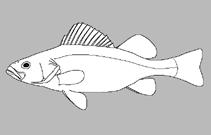
No image available for this species; drawing shows typical species in Percidae.
分類 / 名稱 俗名 | 同種異名 | Catalog of Fishes(屬, 種) | ITIS | CoL | WoRMS | Cloffa
Teleostei > Perciformes/Percoidei (Perchs) 鱸形目 (Perchs) > Percidae (Perches) 鱸科 (Perches) > Etheostomatinae
Etymology: Etheostoma:Greek, etheo = to strain + Greek, stoma = mouth; Rafinesque said "various mouths", but Jordan and Evermann suggest the name might have been intended as "Heterostoma (Ref. 45335); xanthovum:Name 'xanthovum' from the ancient Greek word 'xanthos' and Latin word 'ovum', meaning 'yellow' and 'egg', in reference to the yellow egg-mimic structures on the distal end of the second dorsal fin rays in spawning males.
背棘 (總數) : 7 - 10; 背的軟條 (總數) : 11 - 13; 臀鰭軟條: 7 - 8. This species is distinguished from its congeners by the following set of characters: absence of modified scales along the midline and translucent skin; presence of a row of three black spots at the base of the caudal fin and dorsal fin rays that extend beyond the fin margin in breeding males; lateral line is incomplete with 41 to 55 lateral line scales, of which 27 to 47 are pored; transverse scale row 12 to 18; scale rows above lateral line modally, scale rows below lateral line modally 8; scale rows around caudal peduncle 19 to 25; dorsal fin spines modally 9; dorsal fin rays modally 12; pectoral fin rays modally 12; anal fin spines 2; anal fin rays 7 to 8; second dorsal fin rays branch into two to four rays that are equal in length, terminating in yellow keratin knobs referred to as egg-mimics in nuptial males; scaled cheek, opercle, breast, nape, and belly are all scaled (Ref. 137685). Body shape (shape guide): elongated; Cross section: oval.
This species inhabits headwater streams to medium-sized rivers with slow-flowing water and subtstrate mainly composed of sand and gravel. Occurences were also recorded in sloughs and wetlands with soft subtrate of silt and mud over detritus, woody debris, and emergent aquatic vegetation (Ref. 137685).
Wood, J.E., R.C. Harrington, Z.D. Alley, M.R. Thomas, J.W. Simmons and T.J. Near, 2023. A new species of Spottail darter endemic to the Clarks River in Kentucky and Tennessee (Percidae: Etheostomatinae: Etheostoma). Bulletin of the Peabody Museum of Natural History 64(1):11-37. (Ref. 137685)
系統發育多樣性指數 (參考文獻 82804): PD50 = 0.5000 [Uniqueness, from 0.5 = low to 2.0 = high].
Bayesian length-weight: a=0.00676 (0.00303 - 0.01510), b=3.12 (2.94 - 3.30), in cm total length, based on LWR estimates for this Genus-body shape (Ref. 93245).
營養階層 (參考文獻 69278): 3.3 ±0.5 se; based on size and trophs of closest relatives
回復力 (參考文獻 120179): 高度, 族群倍增時間少於 15個月 (Preliminary K or Fecundity.).
釣魚的脆弱性 (Ref. 59153): Low vulnerability (10 of 100). 🛈