การจำแนกประเภท / ชื่อ
ชื่อสามัญ | ชื่อพ้อง | Catalog of Fishes(สกุล, ชนิด) | ITIS | CoL | WoRMS | Cloffa
>
Siluriformes (Catfishes) >
Trichomycteridae (Pencil or parasitic catfishes) > Trichomycterinae
Etymology: Cambeva: Probably derived from the Tupi-Guarani, is a popular name for trichomycterid fishes in southern and south-eastern Brazil (Ref. 119381); luteoreticulata: Name 'luteoreticulata' from the Latin words 'luteus' and 'reticulata', meaning 'yellow' and 'reticulated', in reference to the flank colour pattern of adult specimens.
สิ่งแวดล้อม : สิ่งแวดล้อม / เขตภูมิอากาศ / ระดับความลึก / ระยะการกระจายสินค้า
นิเวศวิทยา
; น้ำจืด สัตว์น้ำหน้าดิน. Subtropical
South America: Brazil.
ขนาด / น้ำหนัก / อายุ
วัยเจริญพันธุ์: Lm ? range ? - ? cm
Max length : 8.2 cm SL เพศผู้/กระเทย; (Ref. 137708)
คำอธิบายสั้นๆ
เครื่องมือที่ใช้ในการแยกชนิดสัตว์,สิ่งมีชีวิตออกจากกัน | สัณฐานวิทยา | ความยาวต่างๆ
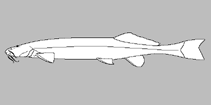
เงี่ยงครีบหลัง (รวม) : 2; ก้านครีบอ่อนที่หาง (รวม) : 7; เงี่ยงครีบก้น: 2; ก้านครีบอ่อนที่ก้น: 5; สัตว์มีกระดูกสันหลัง: 38 - 40. This species is distinguished from its congeners by the following set of characters: unique rounded, stapula-shaped caudal fin in specimens above about 40 mm SL; short barbels, with the nasal barbel not reaching the orbit in specimens above 60 mm SL and maxillary and rictal barbels not reaching the interopercular patch of odontodes; anterior segment of the infraorbital series absent; procurrent caudal-fin rays 21 or 22 dorsal and 15 or 16 ventral; opercular odontodes 10-12; hypertrophied papillae on the head surface absent; narrow nasal barbel; unique pattern of ontogenetic colouration change consisting of flank pale yellow with irregularly shaped and arranged; dark brown to black blotches in specimens below about 40 mm SL, dark brown, with small, irregularly shaped pale yellow marks forming reticulate pattern in larger specimens; 7 pectoral-fin rays; anterior infraorbital absent; posterior margin of the caudal fin convex; pectoral-fin filament absent; 9 or 10 opercular odontodes; 29-32 interopercular odontodes; 15 or 16 ventral procurrent caudal-fin rays; dorsal-fin origin at a vertical through the centrum of the 21st or 22nd vertebra; jaw teeth incisiform, teeth arranged in rows; and 38-–40 vertebrae (Ref. 137708).
Body shape (shape guide): elongated; Cross section: oval.
วงจรชีวิตและพฤติกรรมการผสมพันธุ์
วัยเจริญพันธุ์ | การสืบพันธุ์ | การวางไข่ | เซลสืบพันธ์ของเพศเมีย(ไข่) | ความดกของไข่ | ตัวอ่อน
Costa, W.J.E.M., C.R.M Feltrin, J.L.O Mattos and A.M. Katz, 2024. Top mountain areas of subtropical southern Brazil sheltering four new small-ranged catfishes (Siluriformes, Trichomycteridae): relationships and taxonomy. Evolutionary Systematics. 8:199-218. (Ref. 137708)
สถานะบัญชีแดงของ IUCN (Ref. 130435: Version 2025-2 (Global))
ภัยคุกคามต่อมนุษย์
Harmless
การใช้ของมนุษย์
การประมง: ไม่มีผลประโยชน์
เครื่องมือ
รายงานพิเศษ
ดาวน์โหลด XML
แหล่งที่มาจากอินเตอร์เน็ต
การประมาณค่าตามแบบจำลอง
ดัชนีความหลากหลายทางวิวัฒนาการ (อ้างอิง
82804): PD
50 = 0.5000 [Uniqueness, from 0.5 = low to 2.0 = high].
Bayesian length-weight: a=0.00759 (0.00337 - 0.01709), b=3.00 (2.81 - 3.19), in cm total length, based on LWR estimates for this (Sub)family-body shape (Ref.
93245).
ระดับชั้นอาหาร (อ้างอิง
69278): 3.2 ±0.4 se; based on size and trophs of closest relatives
ความเสี่ยงต่อการตกปลา (Ref.
59153): Low vulnerability (10 of 100).
🛈