Classification / Noms
Noms communs | Synonymes | Catalog of Fishes(Genre, Espèce) | ITIS | CoL | WoRMS | Cloffa
>
Siluriformes (Catfishes) >
Trichomycteridae (Pencil or parasitic catfishes) > Trichomycterinae
Etymology: Cambeva: Probably derived from the Tupi-Guarani, is a popular name for trichomycterid fishes in southern and south-eastern Brazil (Ref. 119381); rotundipinna: Name rotundipinna from the Latin words 'rotundus' and 'pinna', meaning 'rounded' and 'fin or wing', in allusion to the rounded fins of this new species.
Environnement : milieu / zone climatique / profondeur / gamme de distribution
Écologie
; eau douce démersal. Subtropical
South America: Brazil.
Taille / Poids / Âge
Maturité: Lm ? range ? - ? cm
Max length : 7.8 cm SL mâle / non sexé; (Ref. 137708)
Description synthétique
Clés d'identification | Morphologie | Morphométrie
Épines dorsales (Total) : 2; Rayons mous dorsaux (Total) : 7; Épines anales: 2; Rayons mous anaux: 5; Vertèbres: 39. This species is distinguished from its congeners by the following set of characters: relatively short and rounded caudal fin in specimens above about 60 mm SL; procurrent caudal-fin rays 15-17 dorsal and 10 or 11 ventral; jaw teeth irregularly arranged; opercular odontodes 14-17; longer nasal barbel in specimens above 60 mm SL, reaching area between orbit and opercular patch of odontodes; colour pattern of juveniles, in which the flank is light brownish yellow with small black dots irregularly arranged; odontodes 14-17 opercular and 30-34 interopercular; broader autopalatine, with its largest width about equal to its length; posterior process of the parurohyal, its length about one third of the distance between the anterior margin of the parurohyal and the anterior insertion of the posterior process; 7 pectoral-fin rays; absence of the anterior infraorbital; posterior margin of the caudal fin convex; hypertrophied papillae on the ventral surface of the head absent; pectoral-fin filament absent; 9-10 opercular odontodes; 30-34 interopercular odontodes; 15-17 dorsal procurrent caudal-fin rays; 10 or 11 ventral procurrent caudal-fin rays; dorsal-fin origin at a vertical through the centrum of the 21st or 22nd vertebra; jaw teeth pointed, irregularly arranged; and 39 vertebrae (Ref. 137708).
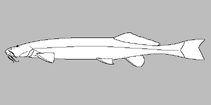
Body shape (shape guide): elongated; Cross section: oval.
Cycle de vie et comportement reproducteur
Maturité | Reproduction | Frai | Œufs | Fécondité | Larves
Costa, W.J.E.M., C.R.M Feltrin, J.L.O Mattos and A.M. Katz, 2024. Top mountain areas of subtropical southern Brazil sheltering four new small-ranged catfishes (Siluriformes, Trichomycteridae): relationships and taxonomy. Evolutionary Systematics. 8:199-218. (Ref. 137708)
Statut dans la liste rouge de l'IUCN (Ref. 130435: Version 2025-2 (Global))
Menace pour l'homme
Harmless
Utilisations par l'homme
Pêcheries: sans intérêt
Outils
Articles particuliers
Télécharger en XML
Sources Internet
Estimations basées sur des modèles
Indice de diversité phylogénétique (Réf.
82804): PD
50 = 0.5000 [Uniqueness, from 0.5 = low to 2.0 = high].
Bayesian length-weight: a=0.00759 (0.00337 - 0.01709), b=3.00 (2.81 - 3.19), in cm total length, based on LWR estimates for this (Sub)family-body shape (Ref.
93245).
Niveau trophique (Réf.
69278): 3.2 ±0.4 se; based on size and trophs of closest relatives
Vulnérabilité de la pêche (Ref.
59153): Low vulnerability (10 of 100).
🛈