Classificatie / Namen
Lokale namen | Synoniemen | Catalog of Fishes(Genus, Soort(en)) | ITIS | CoL | WoRMS | Cloffa
>
Cypriniformes (Carps) >
Nemacheilidae (Brook loaches)
Etymology: Schistura: Greek, schizein = to divide + Greek, oura = tail; an allusion to forked caudal fins (Ref. 45335); sonarengaensis: Name 'sonarengaensis' from the type locality of the species, Krem (= cave) Sonarenga. A noun in apposition.
Milieu: milieu / Klimaatzone / Diepte / verspreidingsgebied
Ecologie
; zoet water demersaal. Subtropical
Asia: India.
Grootte / Gewicht / Leeftijd
Maturiteit: Lm ? range ? - ? cm
Max length : 7.3 cm SL mannelijk / geslacht onbekend; (Ref. 137714)
Korte beschrijving
Determinatiesleutels | Morfologie | Morfometrie
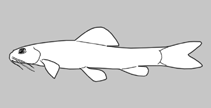
Dorsale zachte stralen (totaal) : 12; Anale zachte stralen: 8; Wervels: 35 - 37. This species is distinguished from its congeners by the following set of characters: a color pattern of 13-26 vertically elongate to circular mid-lateral black blotches (brownish in life) overlayered on a grayish black mid-lateral stripe on a dull white or pale-beige (golden brown in life) body; predorsal color pattern variable consisting of discrete saddles, or combination of saddles and longitudinally elongate anterior most blotches, or two parallel longitudinal stripes, and/or a combination of each; 7-8 discrete sub-dorsal and post-dorsal saddles not contiguous with the mid-lateral stripe, except the posterior most saddle sometimes reaching the stripe; and a short vertical black bar medially occupying the caudal-fin base; dorsal-fin origin nearly opposite to pelvic-fin origin; complete lateral line; short, shallow adipose crest on dorsal and ventral midlines of caudal peduncle; moderately forked caudal fin; axillary pelvic lobe present; prominent processus dentiformes on upper jaw; the chest naked; 9-8 + 8 caudal-fin branched rays; 8½ branched dorsal-fin rays; and no discernible sexual dimorphism (Ref. 137714).
Body shape (shape guide): elongated; Cross section: oval.
This species inhabits a small, stagnant muddy pool measuring approximately 0.5 × 0.8 m2 and about 0.7 m deep, situated roughly 700 m from the main entrance. The substrate of the pool consists predominantly of sand interspersed with scattered pebbles (Ref. 137714).
Levenscyclus en paargedrag
Maturiteit | Voortplanting | Paaien | Eieren | Fecunditeit | Larven
Mukhim, D.K.B., K. Sarma, H. Choudhury, R. Chandran, R. Das, R.K. Singh, D.P. Warbah, U.K. Sarkar and D. Sarma, 2024. Schistura sonarengaensis, a new species of cave-dwelling loach (Teleostei: Nemacheilidae) from Meghalaya, northeast India. J. Fish Biol. 105:1240-1255. (Ref. 137714)
Status op de Rode Lijst van het IUCN (Ref. 130435: Version 2025-2 (Global))
Gevaar voor de mens
Harmless
Gebruik door de mens
Visserij: van geen belang
Tools
Speciale rapporten
Download XML
Internetbronnen
Schattingen op basis van modellen
Fylogenetische diversiteitsindex (Ref.
82804): PD
50 = 0.5000 [Uniqueness, from 0.5 = low to 2.0 = high].
Bayesian length-weight: a=0.00708 (0.00323 - 0.01553), b=3.03 (2.86 - 3.20), in cm total length, based on LWR estimates for this Genus-body shape (Ref.
93245).
Trofisch niveau (Ref.
69278): 3.0 ±0.3 se; based on size and trophs of closest relatives
Weerstandsvermogen (Ref.
120179): Gemiddeld, minimale populatieverdubbelingstijd 1,4-4,4 jaar (Preliminary K or Fecundity.).
Kwetsbaarheid van de visserij (Ref.
59153): Low vulnerability (10 of 100).
🛈