Klassifizierung / Names
Namen | Synonyme | Catalog of Fishes(Gattung, Arten) | ITIS | CoL | WoRMS | Cloffa
>
Cypriniformes (Carps) >
Cobitidae (Spined loaches)
Etymology: Cobitis: Greek, kobitis, -idos = a kind of sardine; also related with the voice Greek, kobios, Latin gobius = gudgeon (Ref. 45335); almadae: Name 'almadae' in honor of researcher Vitor Almada who, with an iron will and overcoming his birth blindness, dedicated his life to the study and conservation of the rivers and fauna of Portugal, the type locality of the species.
Umwelt: Milieu / Klimazone / Tiefenbereich / Verbreitungsgebiet
Ökologie
; süßwasser benthopelagisch. Temperate
Europe: Portugal.
Größe / Gewicht / Alter
Geschlechtsreife: Lm ? range ? - ? cm
Max length : 6.8 cm SL (female)
Kurzbeschreibung
Bestimmungsschlüssel | Morphologie | Morphometrie
Rückenflossenstacheln (insgesamt) : 3; Rückenflossenweichstrahlen (insgesamt) : 7; Afterflossenstacheln: 3; Afterflossenweichstrahlen: 5. This species is distinguished from its congeners by the following set of characters: scales elongated with reduced focus and well-developed lamina circularis; large and low peduncle depth (CPL/BLD > 3.4; APL/BLD > 1.8); a long knife-shaped lamina circularis (Canestrini scale) at the base of the second pectoral fin ray and with a narrow handle in males; lateral ethmoid (suborbital spine) well developed with long narrow mediocaudal, laterocaudal and mediorostral processes; narrow skull with elongated and narrow frontoparietal fontanel; numerous spots on the body in females; well-developed pigmentation in the four Gambetta’s zones; 12-21 (Median = 17.5) small blotches, with third Gambetta’s zone wide and sprinkled with numerous black spots in females, Gambetta’s second and fourth zone spots fused to form two black stripes in males; poorly developed ventral pigmentation in adult individuals, frequently interrupted in the middle of the body; lamina circularis at the base of the second pectoral ray in males; and presence of a large upper caudal spot (Ref. 137754).
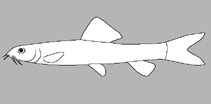
Body shape (shape guide): elongated; Cross section: oval.
Lebenszyklus und Paarungsverhalten
Geschlechtsreife | Fortpflanzung | Ablaichen | Eier | Fruchtbarkeit | Larven
Doadrio, I., C. Sousa-Santos, J. Robalo and S. Perea, 2023. Description of three new species of the genus Cobitis L., 1758 (Actinopterygii, Cobitidae) in the Iberian Peninsula. Limnetica 43(2):1-22. (Ref. 137754)
IUCN Rote Liste Status (Ref. 130435: Version 2025-2 (Global))
Bedrohung für Menschen
Harmless
Nutzung durch Menschen
Fischereien: nicht kommerziell
Tools
Zusatzinformationen
Download XML
Internet Quellen
Schätzungen auf der Grundlage von Modellen
Phylogenetischer Diversitätsindex (Ref.
82804): PD
50 = 0.5000 [Uniqueness, from 0.5 = low to 2.0 = high].
Bayesian length-weight: a=0.00513 (0.00231 - 0.01140), b=3.09 (2.92 - 3.26), in cm total length, based on LWR estimates for this Genus-body shape (Ref.
93245).
Trophische Ebene (Ref.
69278): 3.2 ±0.4 se; based on size and trophs of closest relatives
Widerstandsfähigkeit (Ref.
120179): hoch, Verdopplung der Population dauert weniger als 15 Monate. (Preliminary K or Fecundity.).
Anfälligkeit der Fischerei (Ref.
59153): Low vulnerability (10 of 100).
🛈