>
Cypriniformes (Carps) >
Cobitidae (Spined loaches)
Etymology: Cobitis: Greek, kobitis, -idos = a kind of sardine; also related with the voice Greek, kobios, Latin gobius = gudgeon (Ref. 45335); atlantica: Name 'atlantica' from the type locality of the species, Atlantic drainages in the Iberian Peninsula.
Entorno: milieu / zona climática / rango de profundidad / gama de distribución
Ecología
; agua dulce bentopelágico. Temperate
Europe: Portugal.
Tamaño / Peso / Edad
Madurez: Lm ? range ? - ? cm
Max length : 7.6 cm SL (female)
Descripción breve
Claves de identificación | Morfología | Morfometría
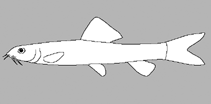
Espinas dorsales (total) : 3; Radios blandos dorsales (total) : 7; Espinas anales: 3; Radios blandos anales: 5. This species is distinguished from its congeners by the following set of characters: short and high peduncle depth (CPL/BLD < 3.6; APL/BLD < 1.4); long knife-shaped lamina circularis (Canestrini scale) at the base of the second pectoral fin ray and with a wide handle in males; lateral ethmoid (suborbital spine) well developed with short and wide mediocaudal, laterocaudal and mediorostral processes; wide skull with short and wide frontoparietal fontanel; pigmentation pattern is variable and is well-developed pigmentation in the four Gambetta’s zones; developed ventral pigmentation in adult individuals, frequently interrupted in the middle of the body; 10-16 blotches (Median = 13) on Gambetta’s fourth row in females, reaching the ventral pigmentation in the caudal region and third Gambetta’s zone narrow with black spots; Gambetta’s second and fourth zone spots fused to form two black stripes in males; caudal fin base spots with the superior one reduced to lesser than eye diameter; presence in the male of a lamina circularis at the base of the second pectoral ray (Ref. 137754).
Body shape (shape guide): elongated; Cross section: oval.
Ciclo vital y comportamiento de apareamiento
Madurez | Reproducción | Puesta | Huevos | Fecundidad | Larva
Doadrio, I., C. Sousa-Santos, J. Robalo and S. Perea, 2023. Description of three new species of the genus Cobitis L., 1758 (Actinopterygii, Cobitidae) in the Iberian Peninsula. Limnetica 43(2):1-22. (Ref. 137754)
Situación en la Lista Roja de la UICN (Ref. 130435: Version 2025-2 (Global))
Amenaza para el ser humano
Harmless
Usos humanos
Pesquerías: sin interés
Herramientas
Informes especiales
Descargar XML
Fuentes de Internet
Estimaciones basadas en modelos
Índice de diversidad filogenética (Referencia
82804): PD
50 = 0.5000 [Uniqueness, from 0.5 = low to 2.0 = high].
Bayesian length-weight: a=0.00513 (0.00231 - 0.01140), b=3.09 (2.92 - 3.26), in cm total length, based on LWR estimates for this Genus-body shape (Ref.
93245).
Nivel trófico (Referencia
69278): 3.2 ±0.4 se; based on size and trophs of closest relatives
Resiliencia (Referencia
120179): Alto, población duplicada en un tiempo mínimo inferior a 15 meses (Preliminary K or Fecundity.).
Vulnerabilidad pesquera (Ref.
59153): Low vulnerability (10 of 100).
🛈