Klassifizierung / Names
Namen | Synonyme | Catalog of Fishes(Gattung, Arten) | ITIS | CoL | WoRMS | Cloffa
>
Ovalentaria/misc (Various families in series Ovalentaria) >
Pomacentridae (Damselfishes) > Pomacentrinae
Etymology: Amphiprion: Greek, amphi = on both sides + Greek, prion, -onos = saw (Ref. 45335); maohiensis: Specific name after ma’ohiensis, which in Polynesian means belonging to the native land, ma’ohi.
Umwelt: Milieu / Klimazone / Tiefenbereich / Verbreitungsgebiet
Ökologie
seewasser riff-verbunden. Tropical
Verbreitung
Territorien | FAO Gebiete | Ökosysteme | Vorkommen | Punkt Karte | Einführungen | Faunafri
Eastern Central Pacific: French Polynesia.
Größe / Gewicht / Alter
Geschlechtsreife: Lm ? range ? - ? cm
Max length : 16.5 cm TL Männchen/unbestimmt; (Ref. 137739)
Kurzbeschreibung
Bestimmungsschlüssel | Morphologie | Morphometrie
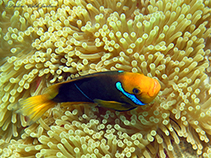
This species is distinguished by the following set of characters: D X-XI,17; A II 14-15, tubed lateral line scales 35-40; differs from A. chrysopterus, by the dorsal fin length (> 58% of SL in A. maohiensis vs. <56% of SL in A. chrysopterus), and using genetics, species can be unambiguously distinguished both with mitochondrial and nuclear genomic markers (reciprocally monophyletic clades). Colouration: when alive, adult with iris dark; body, light orange to dark yellow; two white to bluish bars, with the first behind the eye, the second midbody; all fins are orange (Ref. 137739).
Body shape (shape guide): short and / or deep; Cross section: compressed.
Found usually in association with Radianthus magnifica (= Heteractis magnifica), the magnificent sea anemone, which is also by very far the most common sea anemone in French Polynesia. Other less common sea anemone species may also be found and may be associated with this species, indicating no exclusive association with R. magnifica of this species (Ref. 137739).
), the magnificent sea anemone, which is also by very far the most common sea anemone in French Polynesia. Other less common sea anemone species may also be found and may be associated with this species, indicating no exclusive association with R. magnifica
Lebenszyklus und Paarungsverhalten
Geschlechtsreife | Fortpflanzung | Ablaichen | Eier | Fruchtbarkeit | Larven
O'Donnell, J.L., R. Beldade, J. Johns and G. Bernardi, 2025. A new species of Anemonefish from French Polynesia, Amphiprion maohiensis, (Pomacentridae, Amphiprioninae), the Polynesian anemonefish. ZooKeys 1244:225-237. (Ref. 137739)
IUCN Rote Liste Status (Ref. 130435: Version 2025-2 (Global))
Bedrohung für Menschen
Harmless
Nutzung durch Menschen
Fischereien: kommerzielles potential
Tools
Zusatzinformationen
Download XML
Internet Quellen
Schätzungen auf der Grundlage von Modellen
Phylogenetischer Diversitätsindex (Ref.
82804): PD
50 = 0.5000 [Uniqueness, from 0.5 = low to 2.0 = high].
Bayesian length-weight: a=0.02344 (0.01149 - 0.04783), b=2.98 (2.80 - 3.16), in cm total length, based on LWR estimates for this (Sub)family-body shape (Ref.
93245).
Trophische Ebene (Ref.
69278): 2.7 ±0.3 se; based on size and trophs of closest relatives
Widerstandsfähigkeit (Ref.
120179): mittel, Verdopplung der Population dauert 1,4 - 4,4 Jahre. (Preliminary K or Fecundity.).
Anfälligkeit der Fischerei (Ref.
59153): Low vulnerability (10 of 100).
🛈