Klassifizierung / Names
Namen | Synonyme | Catalog of Fishes(Gattung, Arten) | ITIS | CoL | WoRMS | Cloffa
>
Cyprinodontiformes (Rivulines, killifishes and live bearers) >
Rivulidae (Rivulines) > Cynolebiinae
Etymology: bonita: Name 'bonita' in honor of Maria Gomes de Oliveira, known as 'Maria Bonita' the most prominent woman leader within the ‘cangaço’ social movement in the early XX century and in allusion to the antonymy to the adjective ‘feia’ (ugly), present in the name of the Furna Feia National Park, the type locality of the species.
Umwelt: Milieu / Klimazone / Tiefenbereich / Verbreitungsgebiet
Ökologie
; süßwasser benthopelagisch. Tropical
South America: Brazil.
Größe / Gewicht / Alter
Geschlechtsreife: Lm ? range ? - ? cm
Max length : 5.0 cm SL Männchen/unbestimmt; (Ref. 137857)
Kurzbeschreibung
Bestimmungsschlüssel | Morphologie | Morphometrie
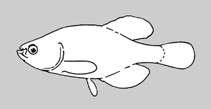
Rückenflossenweichstrahlen (insgesamt) : 15 - 25; Afterflossenweichstrahlen: 19 - 24; Wirbelzahl: 30. This species is distinguished from its congeners by the following set of characters: scale rows around caudal peduncle 12-14; yellowish brown dorsal fin; pelvic-fin rays 6; neuromasts on infraorbital series 15-19; parietal neuromasts 4; contact organs absent; dorsal-fin rays 21-25; caudal-fin rays 22-25; dorsal-fin origin at vertical through base of 2nd-3nd anal fin ray, in males; filaments at tip of dorsal and anal fins in adult males 3; number of longitudinal series scales 28-30; scales transverse series counts 12; oblique position of dark grey bar in eye; iridescent blue dots in the body and caudal fin present; number of vertebrae 30; and narrow head width in males 51.3-64.1% HL (Ref. 137857).
Body shape (shape guide): fusiform / normal; Cross section: compressed.
Lebenszyklus und Paarungsverhalten
Geschlechtsreife | Fortpflanzung | Ablaichen | Eier | Fruchtbarkeit | Larven
Abrantes, Y.G., T.P.A. Ramos, D.D.M. Bento and S.M.Q. Lima, 2023. Molecular delimitation of the seasonal killifishes of the Hypsolebias antenori species group (Cyprinodontiformes, Rivulidae), with description of two new species from the Caatinga coastal basins, northeastern Brazil. Zootaxa 5389(5):545-562. (Ref. 137857)
IUCN Rote Liste Status (Ref. 130435: Version 2025-2 (Global))
Bedrohung für Menschen
Harmless
Nutzung durch Menschen
Fischereien: nicht kommerziell
Tools
Zusatzinformationen
Download XML
Internet Quellen
Schätzungen auf der Grundlage von Modellen
Phylogenetischer Diversitätsindex (Ref.
82804): PD
50 = 0.5000 [Uniqueness, from 0.5 = low to 2.0 = high].
Bayesian length-weight: a=0.01122 (0.00514 - 0.02450), b=3.04 (2.87 - 3.21), in cm total length, based on all LWR estimates for this body shape (Ref.
93245).
Trophische Ebene (Ref.
69278): 3.2 ±0.4 se; based on size and trophs of closest relatives
Widerstandsfähigkeit (Ref.
120179): hoch, Verdopplung der Population dauert weniger als 15 Monate. (Preliminary K or Fecundity.).
Anfälligkeit der Fischerei (Ref.
59153): Low vulnerability (10 of 100).
🛈