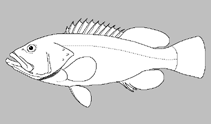
Classification / Noms
Noms communs | Synonymes | Catalog of Fishes(Genre, Espèce) | ITIS | CoL | WoRMS | Cloffa
>
Perciformes/Serranoidei (Groupers) >
Serranidae (Sea basses: groupers and fairy basslets)
Etymology: Hypoplectrus: Greek, hypo = under + Greek, plektron = sting, spur (Ref. 45335); espinosai: Named for Héctor Salvador Espinosa Pérez (1954-2022), a dedicated Mexican ichthyologist, founder of the Mexican Ichthyological Society and curator of the Mexican National Fish Collection.
Environnement : milieu / zone climatique / profondeur / gamme de distribution
Écologie
marin récifal; profondeur 1 - 20 m (Ref. 137920). Tropical
West Atlantic: southern Gulf of Mexico, Mexico (Campeche Bank).
It could be considered of Least Concern given the remoteness of its geographic distribution in coral reefs from the cays of Campeche Bank (which is more than 140 km from the coast of the Yucatan Peninsula).
Taille / Poids / Âge
Maturité: Lm ? range ? - ? cm
Max length : 9.8 cm TL mâle / non sexé; (Ref. 137920)
Description synthétique
Clés d'identification | Morphologie | Morphométrie
Épines dorsales (Total) : 10; Rayons mous dorsaux (Total) : 15; Épines anales: 3; Rayons mous anaux: 7. This species is distinguished from all its congeners by its coloration: body white with thin vertical lines but there are no bars (or very faint); snout with black spot surrounded by electric blue lines; caudal peduncle entirely covered by a black saddle blotch, extending over posterior part of body and sometimes, over posterior part of dorsal fin; no black eye-mask (Ref. 137920).
Body shape (shape guide): short and / or deep; Cross section: compressed.
This species is mostly associated with shallow coral-reef habitats. Reported to be diurnal and solitary, and not observed displaying aggressive mimicry behavior as H. unicolor in Panama (Ref. 137920).
Cycle de vie et comportement reproducteur
Maturité | Reproduction | Frai | Œufs | Fécondité | Larves
Puebla, O., A. Aguilar-Perera, M. Helmkampf, D.R. Robertson, C.J. Estapé,
A.M. Estapé and O. Domínguez-Domínguez, 2025. Hypoplectrus espinosai sp. nov. (Teleostei: Serranidae), a new hamlet on coral reefs in the southwestern Gulf of Mexico. Zootaxa 5618(4):509-524. (Ref. 137920)
Statut dans la liste rouge de l'IUCN (Ref. 130435: Version 2025-2 (Global))
Menace pour l'homme
Harmless
Utilisations par l'homme
Outils
Articles particuliers
Télécharger en XML
Sources Internet
Estimations basées sur des modèles
Indice de diversité phylogénétique (Réf.
82804): PD
50 = 0.5000 [Uniqueness, from 0.5 = low to 2.0 = high].
Bayesian length-weight: a=0.01778 (0.00686 - 0.04609), b=3.03 (2.80 - 3.26), in cm total length, based on LWR estimates for this (Sub)family-body shape (Ref.
93245).
Niveau trophique (Réf.
69278): 3.6 ±0.4 se; based on size and trophs of closest relatives
Résilience (Réf.
120179): Haut, temps minimum de doublement de population inférieur à 15 mois (Preliminary K or Fecundity.).
Vulnérabilité de la pêche (Ref.
59153): Low vulnerability (10 of 100).
🛈