>
Gobiiformes (Gobies) >
Gobiidae (Gobies) > Gobiinae
Etymology: Trimma: Greek, trimma, -atos = something crushed (Ref. 45335); berumeni: Named after Michael L. Berumen, in recognition of his substantial contributions to our understanding of the ecology and biodiversity of Red Sea coral reefs.
Ambiente: milieu / zona climática / intervalo de profundidade / gama de distribuição
Ecologia
marinhas bentopelágico; intervalo de profundidade 15 - 30 m (Ref. 138039). Tropical
Western Indian Ocean: Red Sea, Saudi Arabia.
Tamanho / Peso / Idade
Maturidade: Lm ? range ? - ? cm
Max length : 1.4 cm SL macho/indeterminado; (Ref. 138039); 1.1 cm SL (female)
Descrição breve
Chaves de identificação | Morfologia | Morfometria
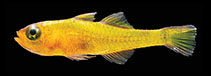
Espinhos dorsais (total) : 7; Raios dorsais moles (total) : 7. This species is distinguished by the following set of characters: predorsal midline with 7-8 scales; fifth pelvic-fin ray is unbranched and 40–42% length of fourth ray; cheek and opercle are scaleless; all pectoral-fin rays unbranched; D VI + I,7; no elongate spines in dorsal fin; bony interorbital width 81–84% of pupil diameter. Colouration: body bright yellow throughout and without bars in life; iris golden-yellow with melanophores except for the golden ring around pupil and inverted golden triangle extending from ventral margin of pupil; fins are translucent with yellow-green longitudinal band in central third of dorsal fins; a thin black midlateral line from above pectoral-fin base to the caudal-fin base, visible in life and in preservative (Ref. 138039).
Body shape (shape guide): fusiform / normal; Cross section: oval.
This species inhabits caves of exposed offshore reefs, where it moves along the surface of cave roofs and walls in small groups of three to ten individuals (occasionally it is also solitary). It is usually found deep within caves, rarely seen within the first 80 cm of a cave entrance. Its habitat is similar to that of its sister species, Trimma winchi, in the Seychelles (Ryan Daly pers. comm.). Specimens were collected at depths between 15 and 30 m, only two specimens were observed shallower than 20 m, it is relatively common in caves at 30 m. Samplings and surveys were limited to 30 m, but it is likely that the species extends to greater depths. The species is observed this species exclusively on reefs with steep walls that extend well into the mesophotic (Ref. 138039).
Ciclo de vida e comportamento de acasalamento
Maturidade | Reprodução | Desova | Ovos | Fecundidade | Larvas
Peinemann, V.N., L. PomboAyora, W.A. Rich, M.D. Fox and D.J. Coker, 2025. A new cave-dwelling species of Trimma (Teleostei, Gobiidae) from the Red Sea, with notes on Red Sea endemism in Trimma spp. ZooKeys 1255:77-93. (Ref. 138039)
Categoria na Lista Vermelha da IUCN (Ref. 130435: Version 2025-2 (Global))
Ameaça para o homem
Harmless
Utilização humana
Pescarias: sem interesse
Ferramentas
Relatórios especiais
Descarregue XML
Fontes da internet
Estimativas baseadas em modelos
Índice de diversidade filogenética (Ref.
82804): PD
50 = 0.5000 [Uniqueness, from 0.5 = low to 2.0 = high].
Bayesian length-weight: a=0.01023 (0.00477 - 0.02194), b=3.01 (2.83 - 3.19), in cm total length, based on LWR estimates for this (Sub)family-body shape (Ref.
93245).
Resiliência (Ref.
120179): Elevada, tempo mínimo de duplicação da população menor que 15 meses (Preliminary K or Fecundity.).
Vulnerabilidade da pesca (Ref.
59153): Low vulnerability (10 of 100).
🛈