Classification / Noms
Noms communs | Synonymes | Catalog of Fishes(Genre, Espèce) | ITIS | CoL | WoRMS | Cloffa
Élasmobranches (requins et raies) (sharks and rays) >
Carcharhiniformes (Ground sharks) >
Pentanchidae (Deepwater catsharks)
Etymology: Apristurus: a-, Latin privative, i.e., without; pristis, from pristes (Gr.), sawyer (but here meaning saw); oura (Gr.), tail, referring to absence of saw-toothed crest of enlarged dermal denticles along upper edge of caudal fin as found in the closely related Pristiurus (=Galeus) (See ETYFish); iterum: Name 'iterum' from the Latin adverb meaning 'again, a second time, or once more', in allusion to the discovery of a new species of Apristurus.
Environnement : milieu / zone climatique / profondeur / gamme de distribution
Écologie
marin bathydémersal; profondeur 540 - 560 m (Ref. 138162). Subtropical
Western Central Pacific: Australia.
Taille / Poids / Âge
Maturité: Lm ? range ? - ? cm
Max length : 53.7 cm TL (female)
Description synthétique
Clés d'identification | Morphologie | Morphométrie
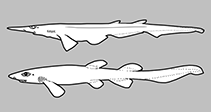
This species is distinguished from its congeners by the following set of characters: head moderately long and broad, head length 22.4% TL, interorbital space 7.0% TL; snout moderately long, pre-oral length 9.3% TL, preorbital length 9.5% TL; mouth very wide, its width 10.7% TL; pelvic-anal space 3.4% TL; anal fin large, base length 17.7% TL, posterior margin 12.5% TL; prepectoral length relatively long, 21.9% TL; labial furrows long, not confined to mouth corners, uppers longer than lowers (3.9 vs. 2.3% TL); enlarged denticles absent on upper or lower caudal fin; 35 monospondylous centra; 35 precaudal-diplospondylous vertebrae; precaudal centra 70; females mature by 537 mm TL; and egg case small (49.4-67.6 mm long), with 10-14 weakly T-shaped ridges on dorsal and ventral surfaces (Ref. 138162)
Body shape (shape guide): elongated.
Facultative air-breathing
Cycle de vie et comportement reproducteur
Maturité | Reproduction | Frai | Œufs | Fécondité | Larves
White, W.T., H.L. O'Neill and S.A. Jayasinghe, 2025. Apristurus iterum, a new shark discovered based on egg case morphology and sequence data obtained from a formalin-fixed specimen. J Fish Biol. 1-17. (Ref. 138162)
Statut dans la liste rouge de l'IUCN (Ref. 130435: Version 2025-2 (Global))
Menace pour l'homme
Harmless
Utilisations par l'homme
Pêcheries: sans intérêt
Outils
Articles particuliers
Télécharger en XML
Sources Internet
Estimations basées sur des modèles
Indice de diversité phylogénétique (Réf.
82804): PD
50 = 0.5000 [Uniqueness, from 0.5 = low to 2.0 = high].
Bayesian length-weight: a=0.00347 (0.00172 - 0.00698), b=3.08 (2.90 - 3.26), in cm total length, based on LWR estimates for this (Sub)family-body shape (Ref.
93245).
Niveau trophique (Réf.
69278): 3.9 ±0.6 se; based on size and trophs of closest relatives
Résilience (Réf.
120179): Haut, temps minimum de doublement de population inférieur à 15 mois (Preliminary K or Fecundity.).
Vulnérabilité de la pêche (Ref.
59153): Moderate vulnerability (41 of 100).
🛈