Classification / Noms
Noms communs | Synonymes | Catalog of Fishes(Genre, Espèce) | ITIS | CoL | WoRMS | Cloffa
>
Eupercaria/misc (Various families in series Eupercaria) >
Cepolidae (Bandfishes) > Owstoniinae
Etymology: Owstonia: Named for Alan Owston (1853‒1915), an amateur naturalist, yachtsman and collector of Asian wildlife, notably fishes from Japan and China; smithvanizi: Name 'smithvanizi' in honor of Dr William (Bill) F. Smith-Vaniz for his great contribution to our knowledge of cepolids and for his generous assistance in our previous paper.
Eponymy: Alan Owston (1853–1915) was an English businessman who was a collector of Asian wildlife, as well as a yachtsman. [...] (Ref. 128868), visit book page.
Environnement : milieu / zone climatique / profondeur / gamme de distribution
Écologie
marin démersal. Subtropical
Northwest Pacific: Taiwan.
Taille / Poids / Âge
Maturité: Lm ? range ? - ? cm
Max length : 19.4 cm SL mâle / non sexé; (Ref. 138346)
Description synthétique
Clés d'identification | Morphologie | Morphométrie
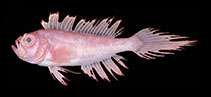
Épines dorsales (Total) : 3; Rayons mous dorsaux (Total) : 21; Épines anales: 1; Rayons mous anaux: 14; Vertèbres: 28. This species is distinguished from its congeners by the following set of characters: lateral-line of type 3, extending beyond dorsal-fin origin but not forming loop, and no contact with posttemporal; D III, 21; A I, 14; gill rakers on outer face of first arch 15-16 + 29-31 = 45-46; oblique body scale rows 49-50; cheek scale rows ca 4-6; vertebrae 11 + 17 = 28; anal-fin pterygiophores anterior to 1st haemal spine 2; preopercular spines 12-14; head length 27.6-28.3% SL; dorsal-fin base length 60.4-62.4% SL; anal-fin base length 30.7-31.9% SL; eye diameter 11.3-12.9% SL; presence of premaxillary stripe; and distal part of dorsal fin with very faint strip between third spine and second soft ray or entirely pale (138346).
Body shape (shape guide): elongated; Cross section: compressed.
Cycle de vie et comportement reproducteur
Maturité | Reproduction | Frai | Œufs | Fécondité | Larves
Su, Y. and H.-C. Ho, 2025. A new species of the bandfish genus Owstonia Tanaka, 1908 (Perciformes, Cepolidae) from Taiwan, northwestern Pacific Ocean, with new records and comments on morphological characters of congeners. ZooKeys 1262:61-80. (Ref. 138346)
Statut dans la liste rouge de l'IUCN (Ref. 130435: Version 2025-2 (Global))
Menace pour l'homme
Harmless
Utilisations par l'homme
Pêcheries: sans intérêt
Outils
Articles particuliers
Télécharger en XML
Sources Internet
Estimations basées sur des modèles
Indice de diversité phylogénétique (Réf.
82804): PD
50 = 0.5000 [Uniqueness, from 0.5 = low to 2.0 = high].
Bayesian length-weight: a=0.00389 (0.00180 - 0.00842), b=3.12 (2.94 - 3.30), in cm total length, based on all LWR estimates for this body shape (Ref.
93245).
Niveau trophique (Réf.
69278): 3.3 ±0.4 se; based on size and trophs of closest relatives
Résilience (Réf.
120179): Haut, temps minimum de doublement de population inférieur à 15 mois (Preliminary K or Fecundity.).
Vulnérabilité de la pêche (Ref.
59153): Low vulnerability (14 of 100).
🛈